
The Making of Match 3D
Written by Ahmetcan Demirel, a true puzzler who plays, analyzes, builds and ships puzzle games.
The puzzle market is still one of the hottest arenas in mobile. Simply because it keeps minting subgenres that actually change what players do minute to minute.
We have seen Block Puzzles pull together to prove they are not just an ad-based market. We have seen the birth of the Sort Puzzles as a “proper” subgenre. And we have seen the invention and evolution of the Screw Puzzles literally from scratch.
Most of that wave came from Hybridcasual Puzzles, built on the blunt combo of IAP (In-App Purchase) plus IAA (In-App Ads). In the meantime, something a bit different was locking in. A Casual Puzzle subgenre that can lean on IAP like Match-3 or Merge, without needing to hide behind ads to pay the bills: Match 3D.
The Match 3D space has amassed over $1B in IAP so far and almost 70% of it comes from two games: Triple Match 3D and Match Factory.
What started as a Hypercasual-style toy has turned into a serious business. Over $1B in IAP revenue, and right now the market is basically a duopoly.
That alone makes it worth a closer look: How Match 3D earned its footing, why it concentrates so hard at the top, and what that says about where this subgenre is heading next.
Before Match 3D Was “Casual”
It is fair to say the Match 3D mechanic was “invented” by a small studio in Turkey: Loop Games. And they did not even try to be clever with naming the game. They called the game that invented this subgenre exactly what it was: Match 3D. I guess when you are the one kickstarting the market, you get to be that blunt.
At its core, Match 3D (the game) was a Hypercasual Puzzle built to drive installs. Simple pitch, instant readability, fast gratification. And it worked. Tilting Point even backed the UA push heavily once the game started showing real legs in the charts.
Match 3D and its Hypercasual level layout.
One detail matters more than people remember: The timer.
Today, timed puzzles are normal with Color Block Jam as its most recent and successful example. Back then, it was not the default in this corner of the market. Match 3D (the game) leaned into time pressure early, and it still worked. That is a strong signal, because timers do not just add “challenge”. They add stress, and stress kills retention unless the base loop is genuinely satisfying and the timer feels like an essential part of the core loop.
And the core loop of Match 3D (the game) was satisfying.
Picking 3D items out of a crowded pile has a tactile, almost fidget-toy feel. You are not matching icons on a flat board. You are digging through clutter, searching, selecting, clearing, and revealing. The pile looks chaotic, but the interaction feels clean. That contrast is the hook.
And despite the simplicity, it generated meaningful IAP in a sustainable way. Because the core loop gave players enough to care.
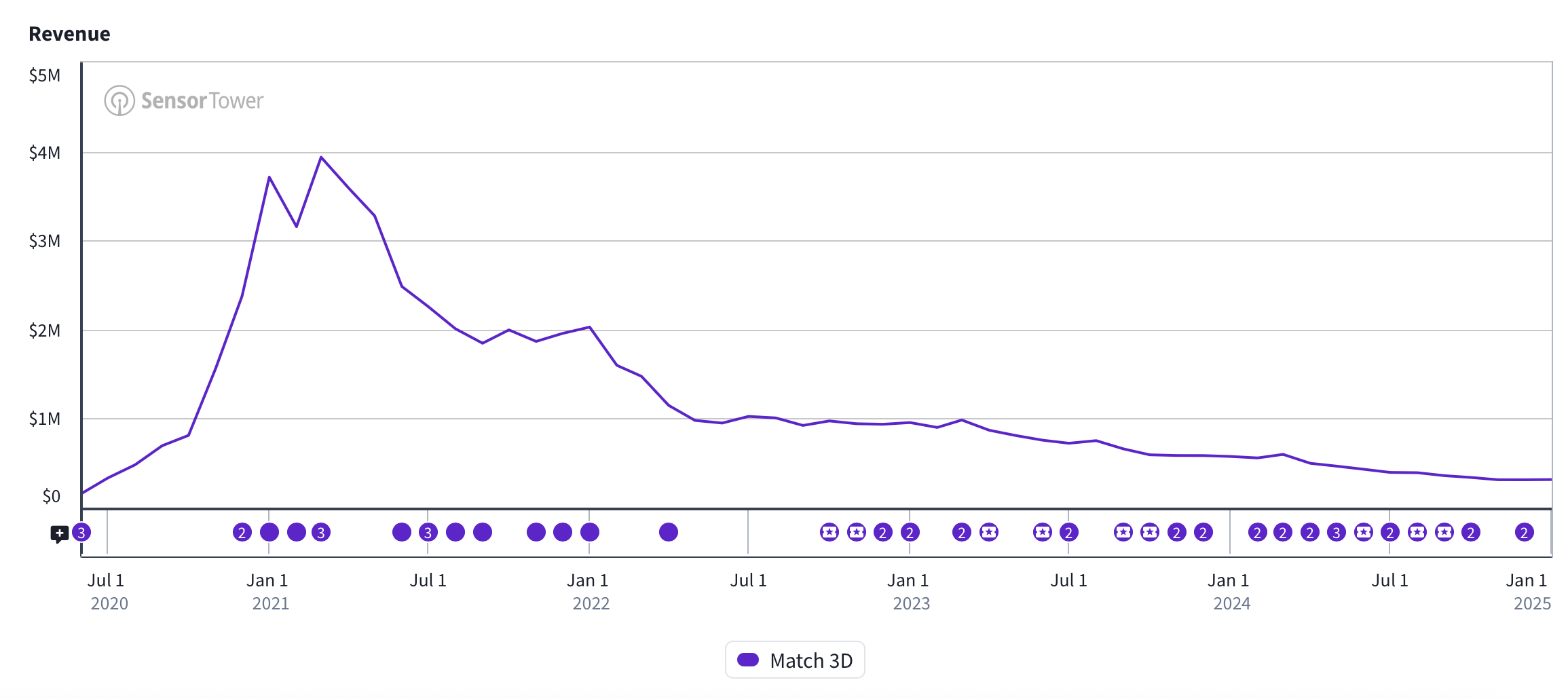
Match 3D had a great run as the inventor of its subgenre.
The market context is important here. The puzzle space was way more conservative. The line between Hypercasual and Casual was clearer. There was no big crowd waiting to crown Match 3D as the next long-term subgenre.
Clones showed up, a few did okay, but none came close to what Match 3D (the game) accomplished. Which is why the story ends the way it usually ends: The original and one of its strongest clone attempts (also from the same studio) got rolled up through acquisition by AppLovin.
Then came the real lag. It took about 1.5 years before someone truly upgraded the formula and turned Match 3D from “surprisingly sticky Hypercasual” into an actual Casual Puzzle category with a deeper design and a clearer long-term content plan.
Not a Toy Anymore
While Match 3D (the game) was changing hands and there was still no real “Match 3D” subgenre, a team out of Israel was quietly building the title that would put the mechanic on the Casual Puzzle map.
Triple Match 3D from Boombox Games, which is part of Miniclip, showed the real potential of this mechanic immediately. It took a genuinely interesting and addictive mechanic and turned it into a strong Casual Puzzle.
The revenue curve tells the story better than anything. Six months to reach $5M monthly IAP, then another six months to hit a record $15M monthly IAP. Even without looking at how the two games looked, it was clear Triple Match 3D was an evolution rather than an iteration. This was the Match 3D mechanic getting upgraded from a novelty to a category anchor.
And the comparison is brutal. Match 3D (the game) topped out around $3M monthly IAP at most, even though it also had meaningful ad revenue. Triple Match 3D did not just outperform it. It blew past it and redefined the scale of what Match 3D could mean.
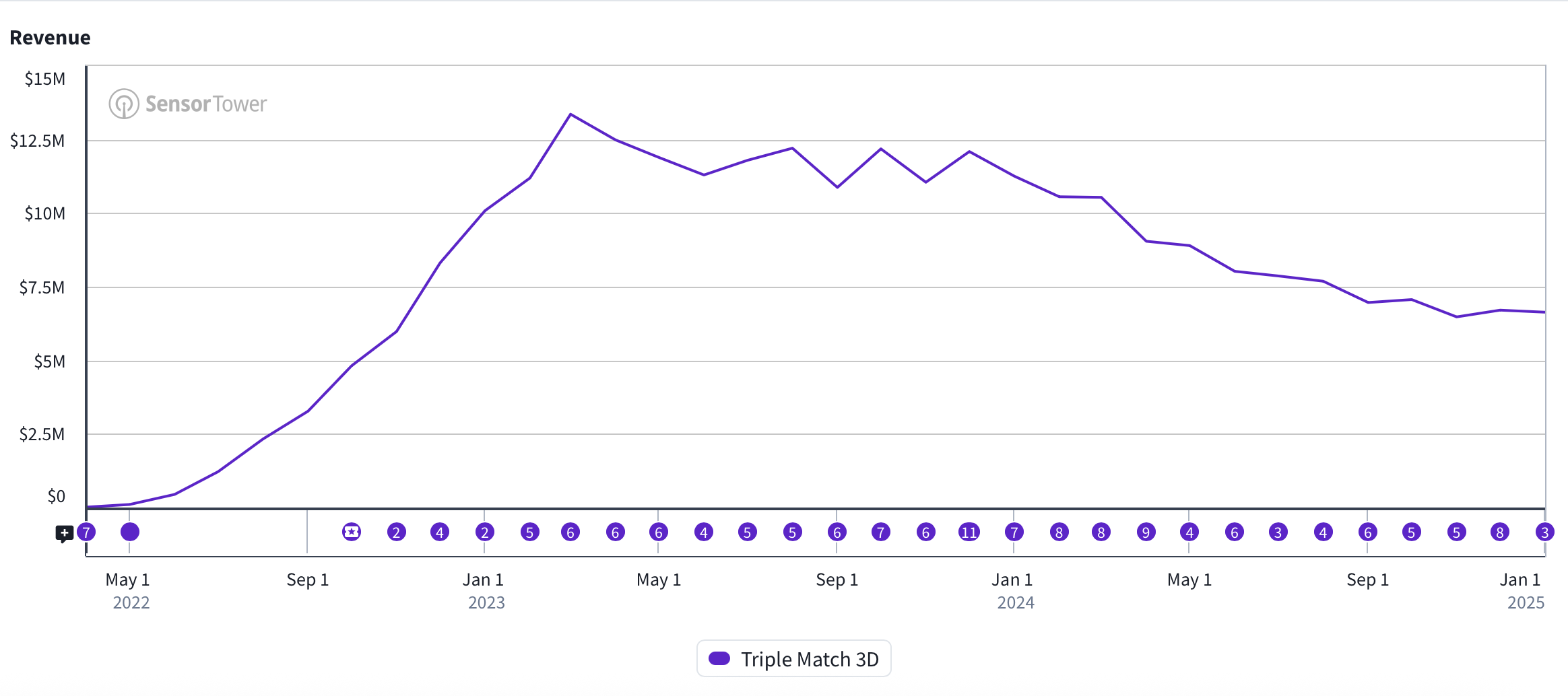
It didn’t take too long for Triple Match 3D to blow past Match 3D in IAP revenue.
Design-wise, this is where things get interesting. Match 3D (the game) was a toy. A delightful one, with a tactile loop and instant satisfaction. But it did not have enough gameplay depth to sustain long-term engagement and long-term IAP at the level a true Casual Puzzle needs.
Triple Match 3D took that same tangible matching fantasy and turned it into a proper puzzle game. And the team deserves full credit here. Creating a whole new Casual Puzzle subgenre is rare.
But what is funny is how little they had to add to change everything.
Triple Match 3D won first by focusing on classical puzzle elements such as level targets and limited dock space.
Triple Match 3D kept the most essential part of the original mechanic: 3D physics. The pile still felt physical. Items still occluded each other. Spotting what you needed still mattered.
Then it made two crucial changes.
First, it replaced drag-and-drop with tap controls. That sounds like a small UX tweak, but it has a huge impact. It removes friction from the core gameplay experience. The whole point of using 3D physics is spotting the item you want and pulling it out of the pile. You do not need to “prove” that with a drag motion every time. Tap made the loop faster, cleaner, and more readable.
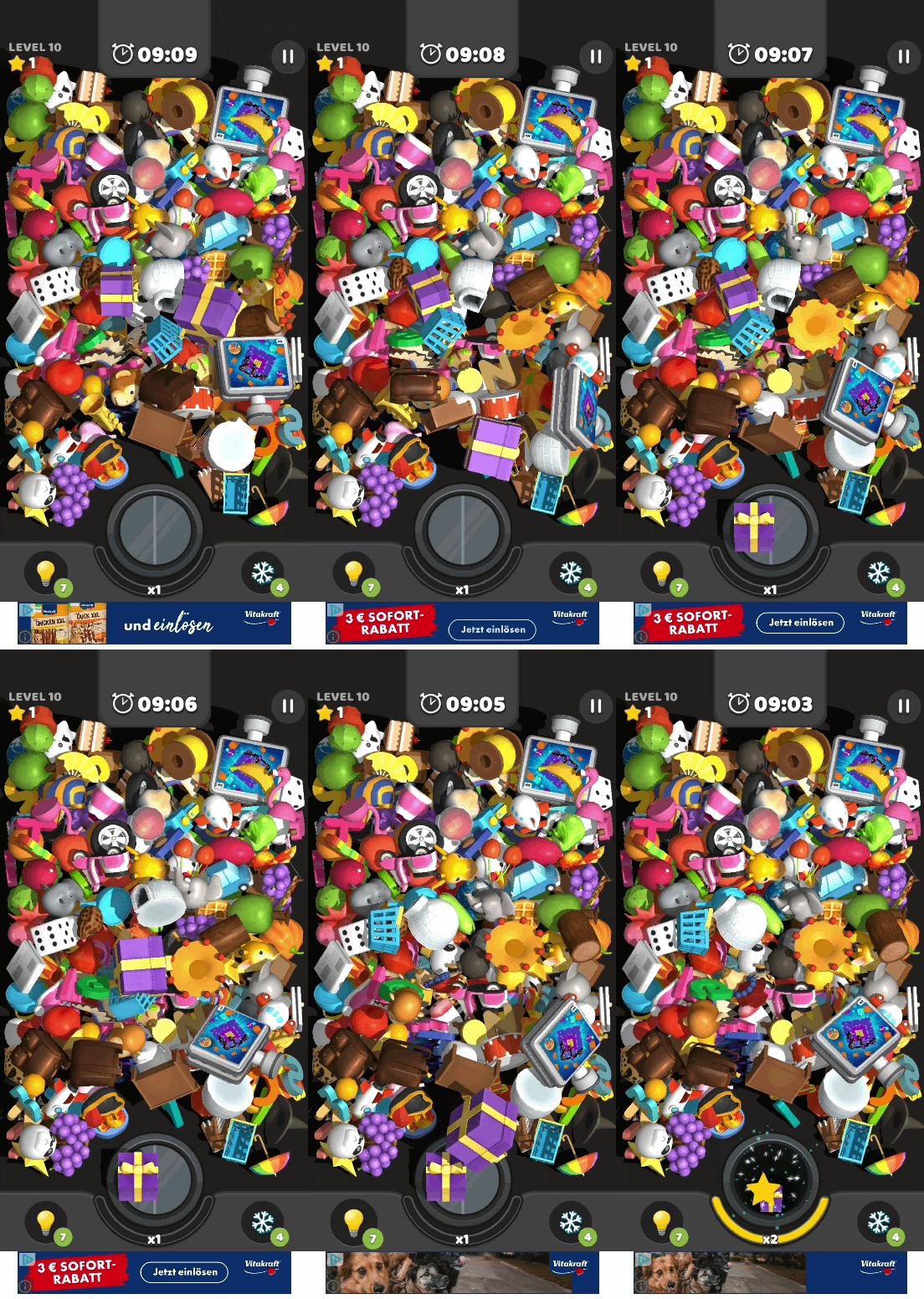
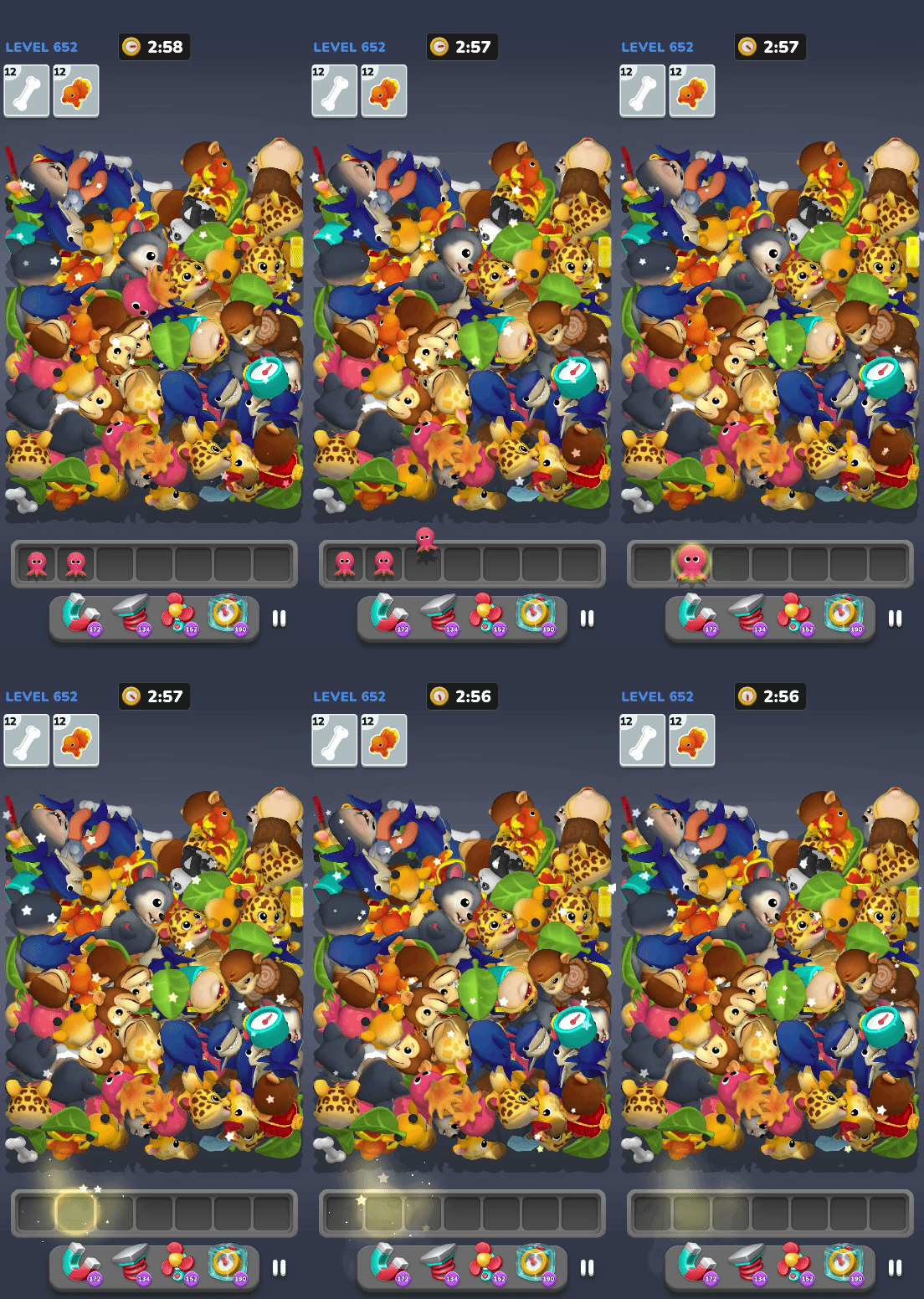
Match 3D (left) vs. Triple Match 3D (right) showing the huge difference between their controls.
Second, it upgraded the matching area into an actual dock with multiple slots, instead of a single-slot “make one match, repeat” setup. This is the real puzzle-making touch. Suddenly you are not just matching. You are managing space. You are planning. You are taking calculated risks to reveal items while not choking your dock.
That is also why the fail condition matters. Those limited slots became the main failure factor instead of a time limit. The tension moved from “can you hurry” to “can you think”. That is how you turn a toy into a game.
Through these two small but decisive changes, Triple Match 3D took a Hypercasual mechanic and turned it into a strong Casual Puzzle subgenre.
And of course, once the playbook was proven, it did not stay an Israel-only story for long. Although Triple Match 3D created the category, it did not take long before another Turkish developer took over the lead…
Turning Noise Into Puzzle
Once Triple Match 3D was out and climbing the top grossing charts, Match 3D stopped being a niche and became an obvious target for bigger puzzle teams. The money was real, the mechanic was validated, and the bar for “this can scale” was already cleared.
The main question was differentiation.
Because if you looked at the Triple Match 3D playbook, it already felt like the “correct” version of the mechanic. Tap controls. Multi-slot dock. Failure driven primarily by space, not a timer. What else was left to fix?
The answer was that the subgenre still needed an experienced puzzle team. Match 3D as a Casual Puzzle subgenre needed an operator, someone who had shipped puzzle hits before, and knew how to turn a strong core loop into a clean funnel with predictable long-term monetization. That is exactly when Peak entered the scene with Match Factory.
And they did not ease into it.
Less than six months after launch, Match Factory took the lead in monthly IAP revenue among Match 3D games and never looked back since.
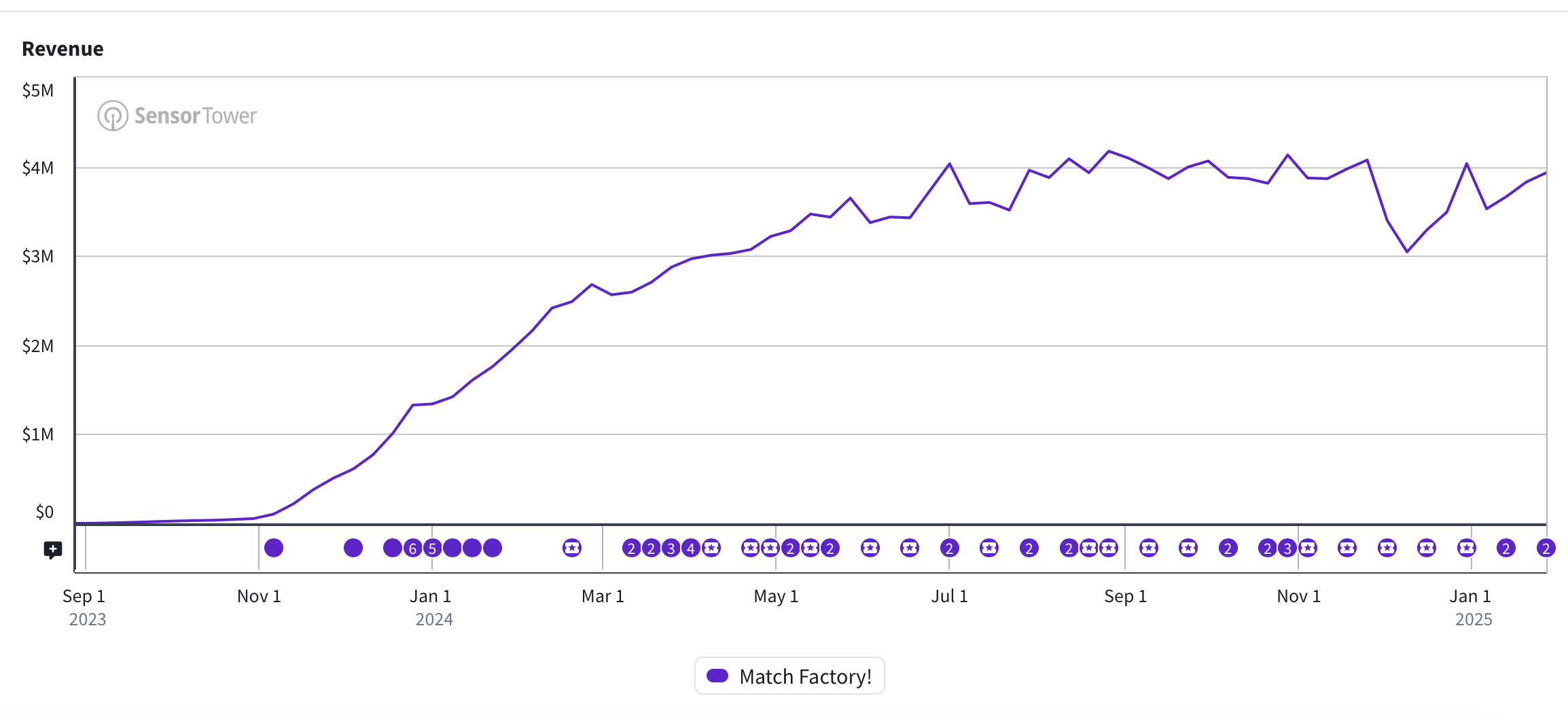
We haven’t seen a single game that could steal market share from Match Factory so far.
A lot could be said about Match Factory, but two changes on top of the Triple Match 3D blueprint explain most of the gap: Aesthetics and level design.
For a long while, Triple Match 3D looked rough. It was printing money, but visually it still carried that “almost Hypercasual” energy. Then Peak showed up with Match Factory wearing the classic Casual Puzzle skin. Cleaner UI, more confidence in the presentation, more “this is a real product” in the first five seconds.
And Peak knows that look better than most. The puzzle market might be full of games cloning Royal Match’s presentation, but Royal Match itself was largely built on the visual lineage Peak helped define with Toon Blast.
Match Factory’s visual upgrade was so obviously superior that it forced a reaction. Triple Match 3D eventually went through a big overhaul to look far more polished, which we have already dug into before.
Then comes level design, which was the real differentiator.
Triple Match 3D was the leap that turned a toy into a business. Match Factory took that business and strapped a rocket to it.
When you play Triple Match 3D, finishing levels does not create a strong sense of progression. The levels are fun in isolation and the challenge variety is solid. But the game does not consistently make you feel like you are moving through a crafted sequence. It is more like a stream of good moments.
Match Factory feels connected. That is hard to do in a mechanic that is inherently chaotic, where 3D physics is both the magic and the mess. Yet Match Factory manages to build an actual puzzle funnel. It gives you controlled ups and downs in difficulty, clear ramping, and that subtle feeling that the game is leading you somewhere instead of just throwing piles at you.
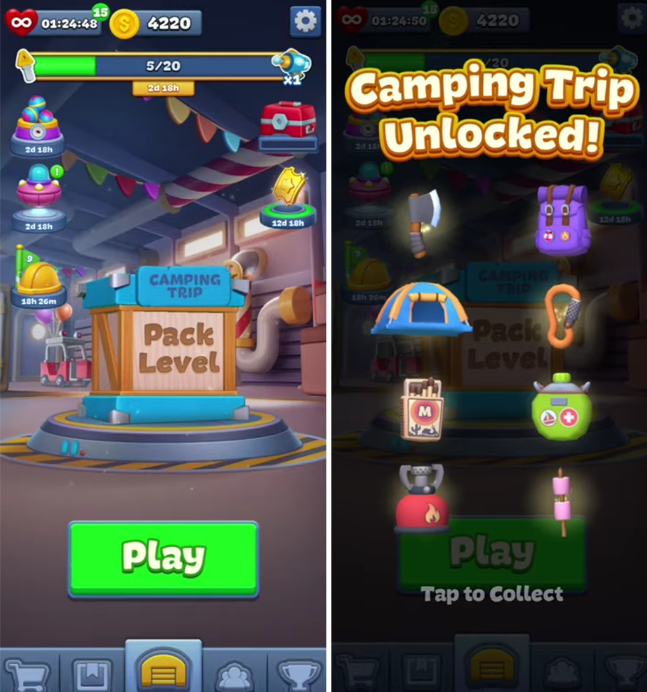
Item packs are a cheap but effective way for Match Factory to make progression feel tangible.
Then it adds a clean extra layer with item packs. Not a huge mechanic, but a very smart progression wrapper. You get a defined set of items for a stretch, then the pack changes and the visual language of the game refreshes. It is an easy way to make levels feel grouped, to make progress feel tangible, and to keep novelty flowing without inventing new systems every week.
The key point is that Match Factory does not surrender to the randomness of 3D physics. It treats that chaos as a lever, then controls it through structure. That is mostly thanks to their experience. They did it in Toy Blast and Toon Blast before. They are doing it again here, establishing absolute domination over the Match 3D space…
No Real Threat on the Horizon
At this point, it is clear that none of the current Match 3D puzzles can even compete with Triple Match 3D, and Triple Match 3D cannot perform anywhere near Match Factory.
But it is also clear the space is not “done”. We have basically seen only three games meaningfully change the trajectory of Match 3D over the last five years. That is not a mature category. That is a category that has been defined by a handful of moves, then everyone else copying the last one.
Which is why I think the next phase will not be about some UI tweak or meta layer bolted on top. It will be led by teams that bring more classical puzzle thinking into the core.
Right now, the most innovative progression element we have seen is Match Factory’s item packs. That should tell you the story. If the best “new” idea in the category is essentially a content wrapper, it means the real design space is still largely untouched.
So, here is the bet. If a new Match 3D game wants a real shot at dethroning Match Factory, it probably needs three things:
Match Factory-level polish: So the first impression is instantly “top-tier casual”
Classic puzzle structure inside the core: Real obstacles + deliberate level layouts that turn physics-chaos into authored challenges.
A progression and difficulty funnel that actually shapes play: Ramps, spikes, resets, and new constraints that change decisions, not just the item set.
It sounds unlikely. And that is exactly why it is worth watching.
