Nobody Told You This About Consulting
So You're a Consultant Now
Over 45,000 people were laid off from gaming in 2022 and 2026. A lot of them are now consultants. Most didn't choose it. I sat down with John Wright to talk about what actually happens after you post "open to opportunities" on LinkedIn. Here's what we wish someone had told us.
After the hiring spree of 2020 to 2022, the gaming industry has been in a downturn. Tens of thousands have lost their jobs. In the US alone, one-third of video game industry workers were laid off in 2025, according to a GDC study. That's a lot of senior operators suddenly "open to opportunities." John Wright, who went from VP at Kwalee to consulting about a year ago, puts it th bluntly: 70% of new consultants in gaming are doing this out of survival, not choice.
To help folks to survive this difficult period in their lives, John and I sat down to talk about what it actually looks like when the LinkedIn post goes up, the likes roll in, and then nothing happens. What follows is what we wish someone had told us. And something we wish will help you to succeed, not just survive, in what is likely an inevitable phase of our careers.
You Just Became a Consultant. Now What?
The first thing that happens when you announce you're consulting is a dopamine hit. John posted his announcement on LinkedIn and received tens of thousands of views and hundreds of likes, which translated into roughly a dozen inbound messages within two weeks.
Sounds great. But a LinkedIn like is not a lead, and a DM is not a signed deal. Here's what those messages actually looked like: seven or eight were from people he already knew. Four were cold. Of the cold ones, three or four were people fishing for free advice dressed up as potential work. Of the total 12, four went to contract. Three went live. That's a 33% conversion rate on the best pipeline he'll ever have, because the announcement wave is the ultimate peak for many.
Six to eight weeks later, inbound dropped to maybe one conversation a week. And that's with John actively doing every conference and speaking gig he could find, plus friends like me passing referrals.
The psychological part nobody prepares you for is the identity collapse. John described genuine anxiety, which surprised him because he's not an anxious person and wasn't in financial distress. It's the shift from "I run 180 people" to "I give advice" that messes with your head. You start doubting whether the skills you built inside a company transfer to the outside. They do, but the doubt doesn't care about evidence.
Here's what I tell people: give yourself time. That initial wave of attention will not convert the way you think it will. The likes on your post are not leads. The coffee chats are not contracts. That's normal. The ramp to something resembling stability takes most people the better part of a year if they're starting cold. John got there faster, inside of 60 days, but he had 15 years of relationships to draw on, plus people actively making introductions for him.
If you don't have that network yet, your timeline is longer, and that's fine. What's not fine is panicking at week six and turning your professional communication into a cry for help. If things are slow, double down on signaling your value add through expert writeups. Those are the best ads you can make.
The Pipeline and Pricing.
John structured his business around day rates with three to five clients, each booking two to five days per month. He built in a volume incentive: one day at full rate, five days at a discounted per-day cost. The logic is sound. It pushes for fewer, deeper relationships, not 20 shallow ones. Stability over volume, in other words.
Beyond straight day rates, the structures vary. Some engagements are goal-based, where the rate increases when targets are hit. Some are rate plus equity, especially with smaller companies that can't afford full fees.
When it comes to equity compensation, my advice is: don't work for free. Warren Buffett's most important rule about making money is not losing it, and your time as a consultant is money. I've taken advisory equity myself, and some of it has paid off. It's a gamble, and you should treat it like one.
On the pipeline side, the conversion funnel is brutal. John learned to push for a no by the third call. I'd say it should happen by the second. After the initial exploratory call, send a proposal. If the next conversation isn't about refining scope and signing, walk away.
The time-wasters are easy to spot once you've met a few: they want your analysis as part of the "interview process," or they want "just one more call" with someone else in their org. Three calls deep with no contract on the table means no contract is coming. It took me a lot of wasted time to become comfortable walking away from “fake leads”.
Seasonality is real and underappreciated. July and December are dead months. If you're working with a European company, they're religious about their time off. Pro-rate your annual income across nine working months, not twelve. The headline number of what you earn per month at peak capacity is not your real income.
One thing John nailed that I want to underscore: succeeding at a consulting engagement can end it. You solve the problem, the client says thank you, and the work disappears. As a consultant, you have to see around the corner. While you're executing on the current project, you should be identifying the next problem worth solving inside that company. If you did good work, the founder doesn't want to lose you. They want you to point at the next thing. Then go and fix it. And when an engagement does end cleanly, that's your moment to ask for references and introductions.
The Actual Consulting Economics
Apart from Matej, nobody in gaming talks about what the money looks like. So let's.
Everyone’s situation is personal. Your connections and reach, your area of expertise, the companies on your resume, the time you can allocate to consulting work, and your geographical location all have a tremendous impact on your income. Furthermore, the longer you do consulting, the more clients you accumulate, leading to a more stable income.
When I began consulting in 2024, my gross revenue for my first year was around 500k, second year around 800k. I spend about three to four days a week helping my clients and another day or two on media and events, which generates similar topline revenues.
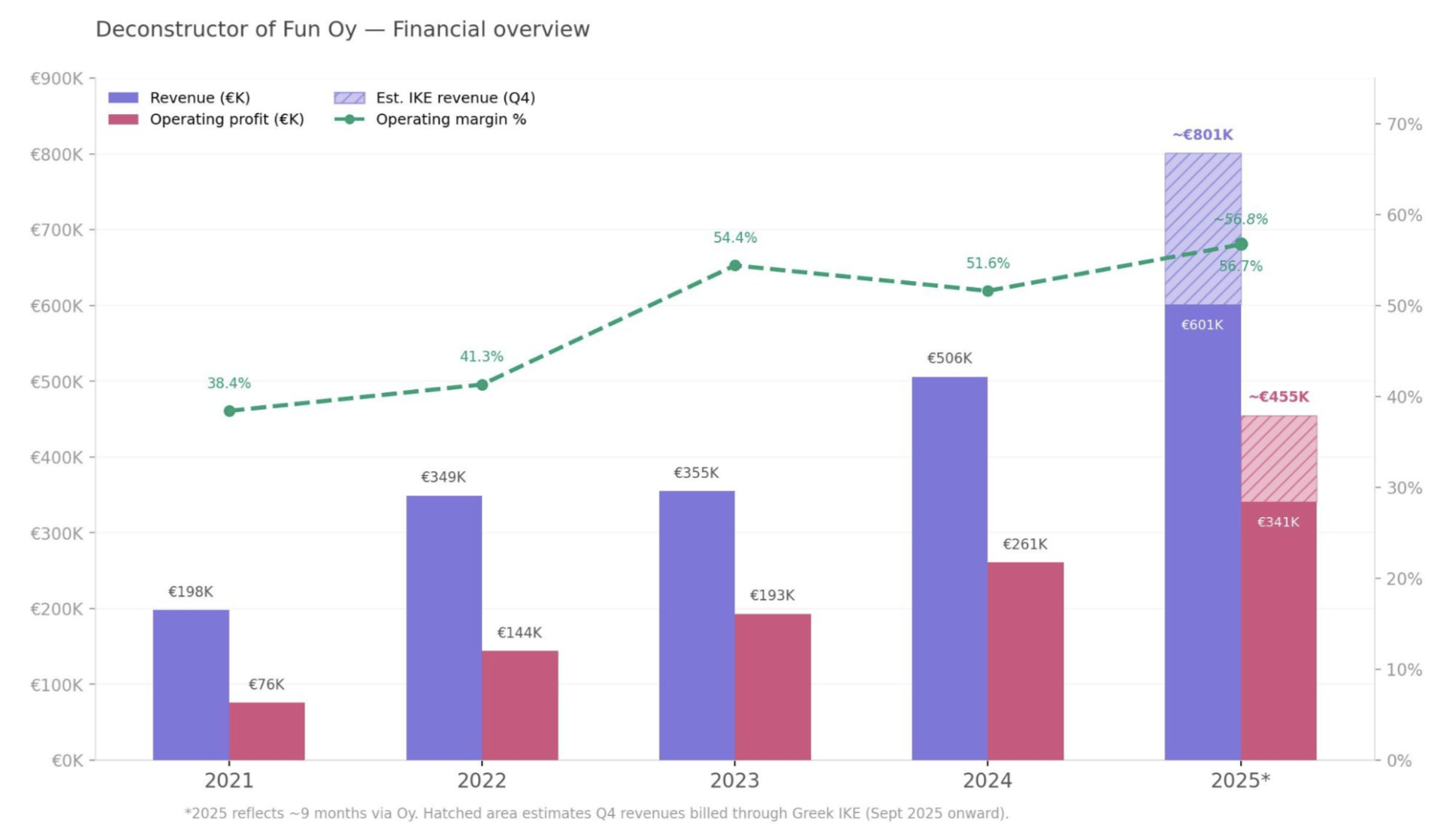
Despite a growing consulting business, I still treat every check as if it’s my last. I guess they call it the “immigrant mindset.”
Consulting has allowed me to work with a variety of companies, from AAA publishers to scaling app developers and gaming infrastructure developers. I’ve even got to work with a global beauty salon chain looking to gamify the way they build their booking experience.
In 2025, I began building a group of diverse experts from genre masters to growth mavens, allowing Deconstructor of Fun to take on not only more projects but also more complicated projects. You can find more about our consulting services here.
For Most, the Consulting Phase Is Still a Phase
Consulting is a stage many of us will pass through, especially now. The industry is putting its resources into AI instead of humans. Senior roles aren't opening at the velocity they did five years ago, and when they do.
So more people will end up consulting, whether they planned to or not. And I think there are a few things worth hearing that nobody is saying.
If you don't have at least three months of financial runway without any consulting income, avoid it. For most, the pipeline doesn't materialize instantly. John said it directly: "Just because you're available does not mean people are going to come to you."
Fractional work compounds more than standalone projects. Your knowledge depreciates to the point where you're just another person with opinions. Fractional roles, where you're embedded 30 to 40 percent of your time in an actual operating company, keep your blade sharp. Fractional has been the single most valuable and fulfilling type of engagement for me.
You won’t have structure, at least not in the beginning. As a consultant, your schedule is dictated by your clients' time zones, not your preferences. If you're working with a US company from Europe, you're taking calls at 9 PM. You're always the boyfriend, never the husband. You bring flowers every day, or you're gone.
Whatever you do, avoid the comparison trap. This is the one that gets people. You look at someone who's been consulting for years, someone with a stable income and a full pipeline and the emotional resilience to handle losing a client without spiraling, and you think you're failing because you're not there yet. You're not failing. We all went through the same brutal early period. The highs and lows get smaller with time. The first lost deal feels like a personal rejection. The twentieth is just Tuesday.
If consulting ends up being a phase for you, make it a useful one. You'll learn more about the industry as a fractional consultant for five companies than by spending five years inside one. You'll build a network that will outlast any single role. And if you eventually go back to being an operator, you'll be sharper for having done it.