
Golden Mechanics: Airbuds
Apps have taken over as the IAP driver on App Store. They must be doing something right. We here at Deconstructor of Fun are here to share the insights.
This deconstruction is from our consulting partner, Vin. Check out our consulting services here - we’ve leveled up some of the hottest and fastest growing apps out there!
Music-centric social networks are a graveyard of valiant attempts. It is in this backdrop that Airbuds, an emerging app with strong Gen-Z appeal, is intriguing. Airbuds boasts 1.5M daily active users and 5M monthly active users; a small base compared to giants Spotify and Apple Music, but its rapid growth and stickiness has attracted $10M in funding from a16z, SV Angel, and Seven Seven Six.
Previous music social networks tried to replace your current listening habits or bolt social into digital music collections. Airbuds is different by staying downstream; it harvests Spotify and Apple Music listening data to create social, interactive events. Events are limited-time, interactive experiences that create variety in daily habit products. Events are a staple in billion-dollar games like Royal Match, Clash Royale, and Monopoly Go, and Airbuds successfully translates their effectiveness into Consumer apps.
Airbuds is able to create lightweight events and passive consumption thanks to Widgets; Airbuds asks its users to install a widget (supported on both Android and iOS) to their home screen to get passive updates without the nag of push notifications. This powerful channel is key to its success; in fact, the app is officially titled “Airbuds Widget”. Events + widgets make this app a daily habit.
Ever-changing Airbuds Widget highlights the different Events happening. Often involving your friends.
In this article, we'll deconstruct three event mechanics that power the Airbuds flywheel: Live Moments, Social Games, and Listening Recaps.
Mechanic #1: “Live Moments” manufacture Serendipity
Live Moments are events tied to real-time listening activity — what your friends are playing right now, what they've had on repeat, when your listening overlaps.
They surface continuously, creating ambient awareness without requiring you to open the app. The design philosophy centers on presence: your friends are out there, listening, right now, and Airbuds makes that visible.
One such event is “Tune Twins”, a notification that fires when you and a friend listen to the same song in a similar time window. The experience starts on the home screen widget, where a Tune Twin alert surfaces alongside your friends' activity. Tap it, and you're dropped into a dedicated screen: the shared song, both profile photos side-by-side, with a prompt to react. The interaction takes five seconds, but the emotional payload is significant. We were thinking about the same thing at the same time, without coordinating.
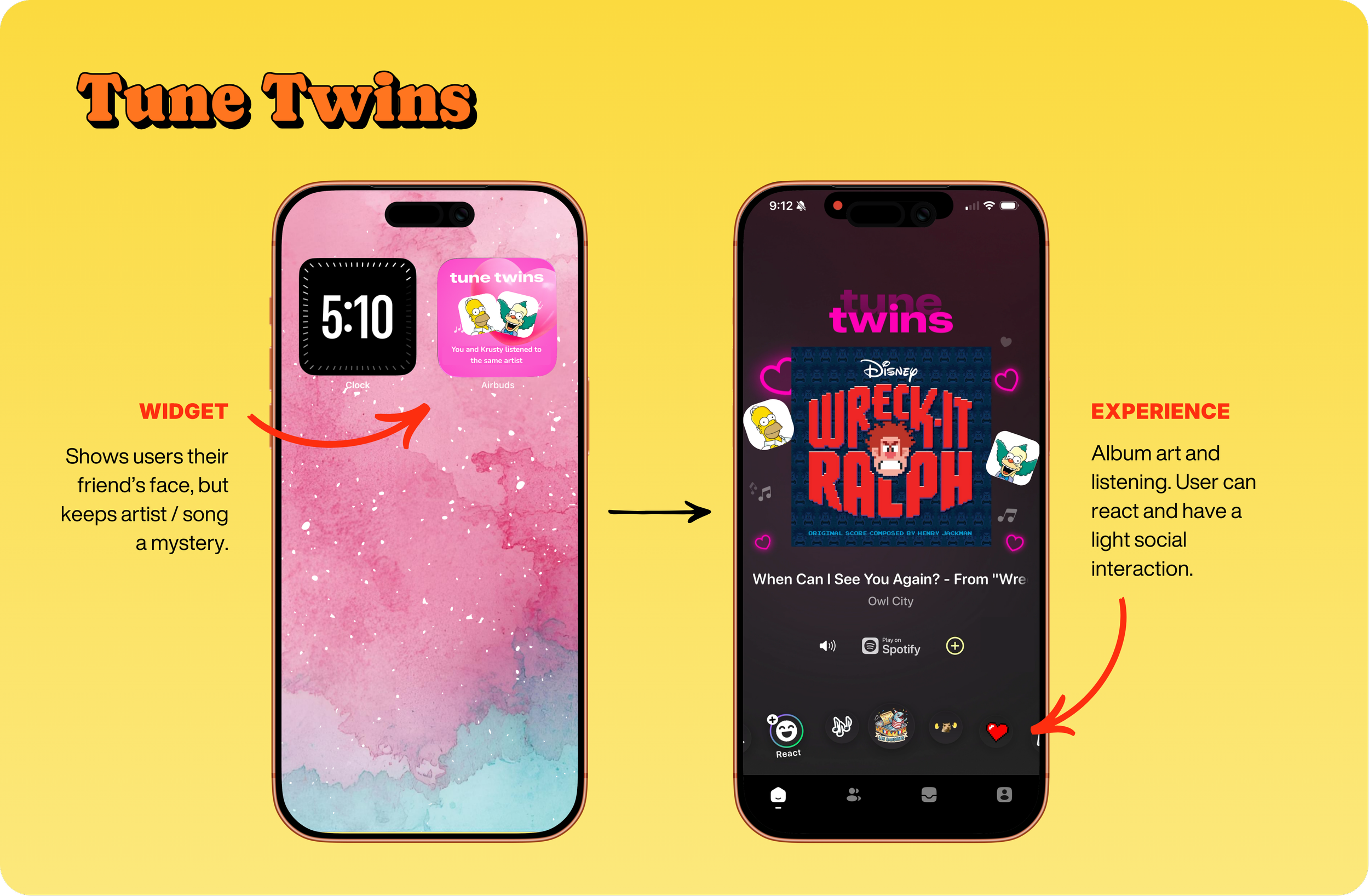
What makes Tune Twins work is manufactured serendipity. The moment feels like coincidence, but the system is designed to surface overlaps and make them visible. Without Airbuds, you'd never know it happened. This is the same mechanic that powers LinkedIn's "mutual connections" or Hinge's "you both liked" — revealing hidden connections users already have. The difference is that Tune Twins happens in real-time, adding urgency and emotional immediacy. You're not learning you had something in common last week; you're learning it right now, while the song is still playing. That immediacy transforms information into a moment worth sharing.
Mechanic #2: “Social Games” create Quantified Relationships
Social Games transform listening data into shareable personality content. They quantify things you feel but can't articulate — how your taste compares to friends, what your music says about you, and package the answers in formats designed for screenshots. The design philosophy centers on externalization: take an internal intuition and give it a number, a label, a shareable artifact.
Airbuds’ “Most Compatible Friend” calculates which of your friends you were most musically compatible with (measured by track and genre choices) in a given week. It is presented as a mystery; tap through, and you will see who you matched with this week. Each friendship becomes quantified, comparable, and, critically, shareable. The format is built for Instagram Stories: clean typography, two names, a big number in the center.
“Most Compatible Friend” works because it gives users a vocabulary for relationships they already feel. You know which friends share your taste, but you've never had a number for it. The score externalizes an intuition, making it concrete and communicable. This is why Spotify Wrapped resonates: it tells you something you already knew but packages it as discovery. Airbuds extends this logic: instead of one annual moment, Compatibility Score refreshes regularly, and the number can rise or fall based on what you both listened to. That movement creates stakes around passive behavior. Users start to notice: we were 84% last week, now we're 71% — what changed? The number turns listening into a relationship barometer, and the fluctuation keeps users checking back.
Mechanic #3: “Recaps” turn passive behavior into Progress
Listening Recaps are periodic summaries that package your listening activity into a record worth reviewing. They drop on a predictable schedule, daily or weekly, creating anticipation and ritual around specific moments. The design philosophy centers on reflection: transform background consumption into something that feels like accumulated effort.
The Airbuds Weekly Recap, delivered every Sunday, is a Wrapped-style summary. Top artists, most-repeated tracks, total minutes, and awards like "#1 Fan" of a specific artist or "Most Minutes Listened" in your friend group. The format is built for sharing, portrait orientation, bold typography, and your stats front and center. But the deeper function isn't distribution; it's ritual. Sunday becomes Airbuds day. Users learn to expect the recap, and expectation creates return.
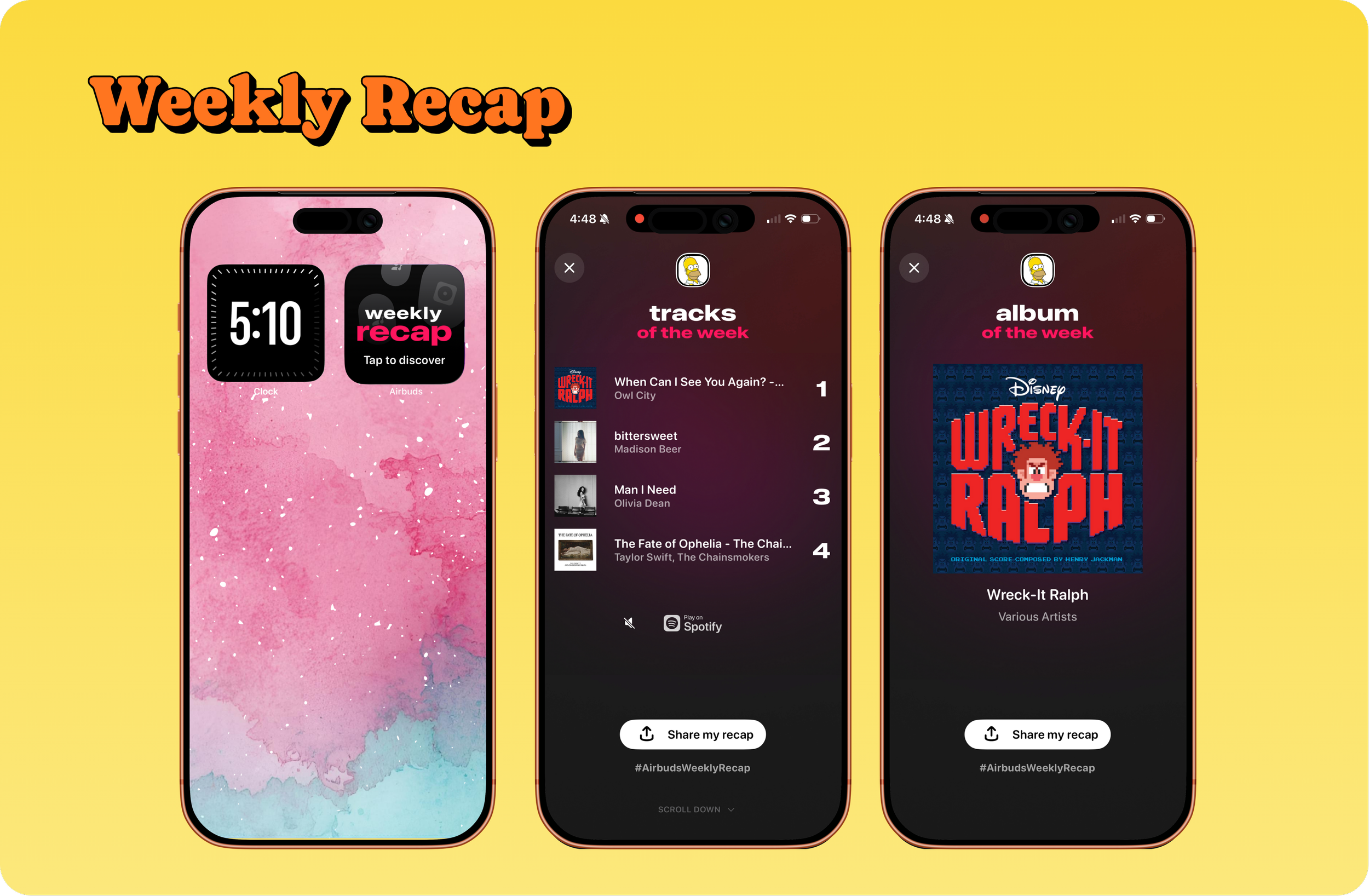
What makes the Weekly Recap work is that it transforms passive consumption into a record worth reviewing. Listening to music doesn't feel like an accomplishment while you're doing it — you're just playing songs. The recap reframes the week as accumulated effort, something worth reflecting on. This is the same psychology behind Strava's weekly mileage, Duolingo's XP summaries, or Peloton's monthly recaps — the summary creates a sense of progress that the underlying activity doesn't provide on its own. The awards layer adds status: being "#1 Fan" means something, even if the threshold is just play count. Users begin to care about what next week's recap will say, which subtly shifts listening from background activity to something worth noticing. The recap doesn't just reflect behavior; it shapes it.
Key Takeaways
Airbuds has taken the annual “Spotify Wrapped” experience and turned it into a daily, social event. These “events” are non-pushy and use Widgets in a novel and meaningful way. Some takeaways:
1. Treat existing datasets as foundational — and create new value on top of it. Airbuds doesn't ask users to change their music habits; it harvests data from behavior that's already happening elsewhere. If your users already do something habitually, build a flywheel that runs on that fuel instead of competing for the same attention.
2. Turn passive behavior into shareable identity. Take user data, reflect it back as personality content, and make it screenshot-ready. Compatibility scores, music mascots, taste percentiles — passive listening becomes active self-expression.
3. Use events to manufacture urgency. Airbuds Events create now-or-never moments; if you forget to tap on it, you might lose that moment. Games learned this years ago; consumer apps are catching up.
4. Design events at multiple cadences. Live moments create continuous micro-engagement. Social games create periodic anticipation. Recaps create weekly rituals. Layer them so there's always a reason to return — today, this week, and next week.
Philosophical Musing
Airbuds' three event mechanics work together as a system. Live moments create continuous awareness; you're always one phone unlock away from seeing what friends are listening to. Social games create anticipation — users check back to see compatibility scores and personality content. Listening recaps create ritual — the capstone that turns a week of passive listening into a shareable identity.
Each mechanic feeds the flywheel. Awareness leads to engagement. Engagement builds investment. Investment drives returns. Returns generate shareable content that brings in new users. The flywheel spins, and Spotify keeps supplying the fuel.
The mechanics that power billion-dollar titles like Royal Match and Monopoly Go — time-boxed moments, periodic refreshes, and shareable outcomes — also power Airbuds, to strong effect.
Airbuds offers a compelling proof point that Events can translate beyond just games. With novel distribution mechanisms (Widgets), Airbuds is a case study in the evolution of social products, powered by Events.
