
Just Dessert vs. Gossip Harbour: Who Merged It Better?
Written by Yael Halevi, aka Merge Queen and casual games strategist, bringing you insights shaped by years of professional Game Design experience and learnings from smash merge hits like Travel Town.
For years, I’ve been following the gaming industry, and one of my favorite things to track is new game releases.
New games do more than just introduce new competitors. They often predict future trends, bring innovation, and show off creative mechanics. Most importantly, they give me insights into what the "next big thing" might be.
I invite you to follow me here! I’ll be sharing bite-sized, insightful posts about interesting new games, why they matter, and my personal take on them.This past May brought us several intriguing titles. However, one that truly stands out is Just Desserts, a new soft-launch title from Chinese gaming giant Century Games, better known for the most successful strategy games, Whiteout Survivals & Kingshot.
Merge 2 Crash Course
For those unfamiliar with the Merge genre, here is a quick catch-up: this genre has skyrocketed in popularity over the last few years, becoming the 2nd highest-grossing in the casual genre after match-3. Furthermore, it has shown phenomenal year-over-year growth, and it’s not slowing down anytime soon.
Right now, the undisputed king of the genre is Gossip Harbor (from Chinese Microfun), which has comfortably cemented its spot as one of the Top 5 highest-grossing mobile games globally.
To give you a quick, no-nonsense crash course on how we got here: Gossip Harbor actually started as a game heavily inspired by Love & Pies (from Trailmix, a Supercell studio). But in a classic student-surpasses-the-master twist, it outworked and evolved into a fierce competitor that has left everyone else in the dust.
But market growth alone doesn’t explain why Merge 2 has become such a powerful genre. To understand what makes these games so engaging, and why the formula has proven so scalable, we need to look under the hood at the core gameplay loop that drives the experience.
The Core Gameplay Loop
The core gameplay loop takes place on a board filled with Producers and orders that give players clear goals to work toward. Players tap Producers to generate items, then merge two items of the same type to progressively reach the items required by orders. Each tap consumes Energy, making it the resource that powers the core loop.Completing these orders rewards players with resources, enables progression, and ultimately allows them to renovate and develop the Meta, the space where the game’s narrative unfolds.
While the board provides the moment-to-moment gameplay, the Meta and its narrative give that gameplay a larger purpose. Players are not simply merging items for the sake of merging, they are completing orders for the characters they have become invested in, using their progress to unlock new areas, advance the story, and see what happens next.The interesting part is that the merge loop doesn’t exist in isolation. While the board provides the actions that keep players busy, the Meta gives those actions meaning. This connection between gameplay and narrative is one of the key reasons Merge 2 games can turn a relatively simple mechanic into such a sticky experience.
Narrative as a Retention Driver
Narrative plays a critical role in the overall experience and is one of the key drivers bringing players back to the game. This is particularly relevant in the Merge 2 genre, where the majority of the audience is female and emotional investment in characters can become a powerful engagement driver.
Love & Pies is one of the strongest examples of this approach. The game established a highly engaging cast of distinctive characters and built a compelling narrative around them, helping it achieve exceptionally strong retention within the genre. Its approach to character-driven storytelling has since become an important benchmark for many Merge 2 titles that followed, including Gossip Harbor.
Importantly, the narrative characters are not disconnected from the core gameplay. They are also the characters requesting orders on the board. This creates a direct relationship between the two layers of the game: the characters provide the motivation, while the board provides the activity through which players help them. Players are effectively “working for” these characters, transforming each merge and completed order into a small contribution toward the larger story.
The “One More Merge” Effect
A major part of what makes the Merge 2 loop so compelling is the perception of constant, achievable progress.
Every order is broken down into smaller merging steps, creating a clear path toward completion. As players get closer to the requested item, the goal feels increasingly attainable- often creating the feeling that they are “just one more merge” away.
This creates a powerful progression illusion: the player is continuously moving forward, but there is always another small step within reach. That combination of visible progress, achievable goals, and incomplete tasks makes disengagement surprisingly difficult.
The board itself reinforces this behavior. Players are constantly balancing several micro-goals at once as they find themselves caught in an almost endless OCD-like loop: generating items, merging, completing orders, freeing up board space, and organizing their inventory. This creates a highly satisfying optimization loop in which players naturally want to “clean up” the board before stopping.
In other words, the game is not only asking players to progress,it is constantly giving them something that feels almost finished.
Energy: The Resource Powering the Economy
At the center of the game economy is Energy, the primary resource governing item generation.
Players spend Energy by tapping Producers, with one tap costing one Energy. This creates a direct relationship between the core gameplay action and the game’s primary resource economy: the more players want to merge and progress, the more Energy they need to generate items.
Energy regenerates automatically at a rate of one Energy every two minutes, with a maximum capacity of 100 Energy. As a result, a fully depleted player can naturally refill their Energy in approximately 3 hours and 20 minutes.
This creates a built-in return loop. Players who want to maximize their free Energy have a clear incentive to return several times throughout the day, turning resource regeneration into a lightweight but effective retention mechanism.
Energy as a Monetization Lever
Energy not only regulates gameplay, but it also creates one of the game’s most important monetization opportunities.
Once players run out of Energy, they are presented with the option to purchase additional Energy using Gems. The cost increases with successive purchases, starting at 10 Gems, followed by 20 Gems, then 40 Gems, and so on. Importantly, the Energy purchase ladder resets daily, making it more than a one-off monetization opportunity: it becomes part of the player’s daily resource routine.
Personally, I find this to be one of the game’s more powerful “slippery slope” monetization areas. The individual purchases feel small and easy to justify; 10, 20, or even 40 Gems can feel like such a low commitment that I barely register them as a meaningful purchase. Yet because the ladder resets every day, these small decisions can quickly become part of my daily routine.
This is one of the few games where I genuinely feel that I have very little resistance to making these small, recurring purchases. The game almost smoothly and subtly nudges me into spending, without any single purchase feeling significant enough to trigger a strong sense of friction. This is a strong example of the foot-in-the-door effect: the first, relatively small purchase lowers the psychological barrier to spending, making the next purchase feel more acceptable, and so on.
That makes the Energy system particularly interesting from a monetization perspective: the strength is not necessarily in the size of the purchase, but in how effortlessly the game turns spending into a habit.This structure leverages a particularly important moment in the player journey: the point at which the player wants to continue playing but has exhausted the resource required to do so.
Because Energy is directly tied to the core gameplay loop, the offer appears at a highly relevant moment. Players are not purchasing an abstract resource; they are purchasing the ability to keep tapping, merging, completing orders, and progressing.
The game also offers bundles that include Energy alongside additional resources, creating a broader monetization layer for players who are looking for more value than a simple Energy refill. But the depth of Energy monetization in Merge 2 deserves an article of its own.
Producer Cooldowns: Another Layer of Friction
Energy is not the only system controlling the pace of item generation. Some Producers also use a cooldown mechanic.
After producing a certain amount of items, a Producer becomes temporarily unavailable. Cooldown duration varies between Producers, and players can either wait for the Producer to recover or spend Gems to skip the cooldown.
This creates a second resource gate that operates alongside Energy. While Energy limits how much players can produce, cooldowns can limit when they can produce it.
From a retention perspective, cooldowns introduce another natural return point: players have a reason to come back once a valuable Producer becomes available again.
From a monetization perspective, they create another opportunity at a moment of high player intent. Players who are deeply engaged in a session may prefer to spend Gems rather than interrupt their momentum and wait.
Social
In terms of social features, there are currently several available, most of which are based on competition between players. Examples of existing features include a point-accumulation tournament (where points are earned by completing orders), a race where the first player to collect a certain amount of coins wins, Lava Quest, Duel, Partner, and more.
At the same time, the genre is increasingly exploring cooperative social experiences. Tasty Travelers recently introduced a cooperative event in which players team up with an ally to complete orders together and earn rewards. While cooperative mechanics such as Partners are already established within the genre, these implementations demonstrate the broader opportunity to create more meaningful forms of collaboration and social engagement.
There is still a lot of potential for additional social events and features within the genre. Features like these can significantly increase engagement and emotional attachment to the game, making them an important part of the overall experience.
Some successful concepts that could work well include introducing Teams and creating more player-to-player interactions, such as sending gifts, trading items with friends at certain levels, and, of course, trading missing cards.
Now that we have a better understanding of what Merge 2 is all about, let’s dive into the delicious new competitor we’re here for— Just Desserts. And honestly, it’s impossible to talk about this game without comparing it to Gossip Harbor — you’ll soon see exactly why.
Just Desserts vs. Gossip Harbor: The Breakdown
Why Just Desserts launch is interesting?
Century Games has already proven its mastery in the Merge-2 space with Tasty Travels, achieving remarkable success and even surpassing top-market titles like Travel Town in revenue. Given their impressive track record, I’ll be closely monitoring this new release, expecting it to set a new benchmark for the genre.
Look & Feel: Heavily inspired by Gossip Harbor, featuring ultra-fine art, smooth gameplay, great animations, and a highly compelling narrative with exciting characters.
Core Gameplay & Board Mechanics
GAMEPLAY
In both games, the core board is designed in blue with light brownlocked tiles, and there is a background that fits the narrative. The blue background provides strong visual contrast with the main chain’s core elements — baking and coffee — helping them stand out more prominently.
LOCKED TILES
When players reveal the locked tiles, they win locked rewards, which drives them to progress through board exploration and encourages their retention.It feels like I'm tactically planning my merges to reach them.
PRODUCERS
Producers are the core engine driving the game loop, generating the addictive tapping gameplay at the heart of the experience. Players start with a single producer and a single chain, unlocking additional chains and producers as they progress.
Energy is the fundamental resource anchoring the game economy, consumed primarily by tapping producers. Each tap generates items that players use to complete orders.
Producers are also the primary drivers of engagement- the core “heroes” that players continuously upgrade throughout their journey.
As players upgrade their producers, the gameplay evolves with them, enhancing the overall experience and creating a growing sense of emotional investment, driven by the sunk-cost effect.
So, what’s the secret to upgrading producers? It all comes back to the game’s core mechanic: merge two of the same kind to create a stronger one.
Players earn low-level producers that can be merged and upgraded into higher-level versions. Upgrading producers fosters a strong sense of achievement and tactical mastery.
And this is where the core mechanic really shines: the same merge action that drives progression also keeps the board constantly evolving. Players are not just upgrading producers, they’re managing space, resources, and future possibilities with every merge.
For the Advanced readers: Recently, Gossip Harbor took this dynamic a step further by moving lower-level producers into a dedicated separate section. Why does that matter? Less clutter, less board friction.
By clearing lower-level producers off the main board, the game reduces the feeling of board pressure and gives players more room to focus on the fun stuff: tapping, merging, and completing orders. And with fewer spatial constraints getting in the way, players can spend their Energy faster, which can ultimately support longer, more fluid play sessions.
In our case-
Both games focus on a small amount of producers (JD producers up to level 14), making it easier for players to stay oriented.
Personally, the dessert chain was my absolute favourite, it’s just so colorful and eye-catching!
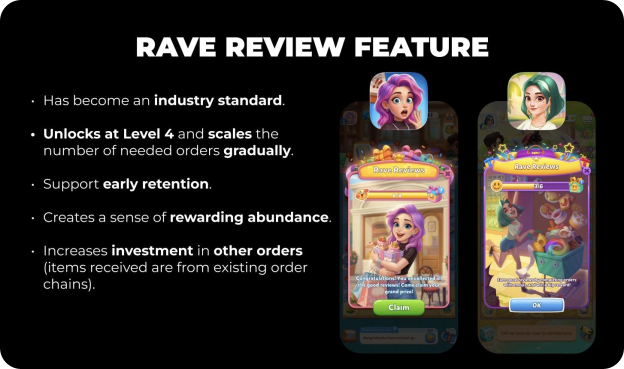
RAVE REVIEW FEATURE
A feature where players need to complete specific orders marked with the Rave icon to earn a reward containing a large quantity of items.Has become an industry standard.
Unlocks at Level 4 and scales the number of needed orders gradually.
Supports early retention.
Creates a sense of rewarding abundance.
Increases investment in other orders (items received are from existing order chains).
The feature includes satisfying and engaging animations both for bar completion (where item rewards fly to the board in a nice arc) and for every completed order and bar progression. Plus, there are reminders that keep you updated on your progress and nudge you to finish just one more order.
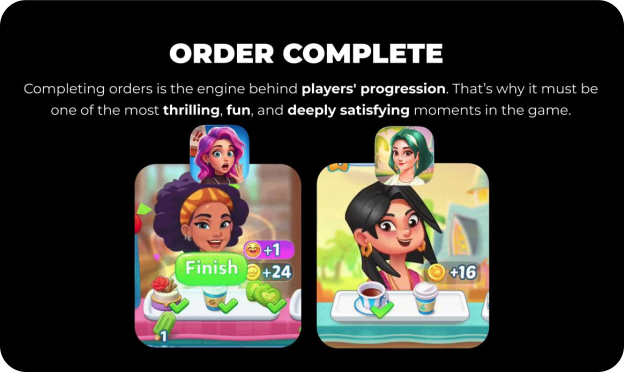
COMPLETING ORDERS
Completing orders is the engine behind players' progression. That’s why it must be one of the most thrilling, fun, and deeply satisfying moments in the game.
Personally, I find completing orders in a continuous sequence to be one of the most exciting experiences in the game.
Additionally, it appears that the Order Engine generates some orders based on the items currently available on the board, creating a stronger sense of relevance and driving higher engagement with those orders.
Monetization & LiveOps
OOE
In both games, the OOE screen shows an energy sale for HC and a promo for the Pass. The price of the energy increases gradually with each purchase.
The interesting part is that when opening this screen in JD, you can also see a focus on the player's HC amount in their inventory, which might make it easier for them to make a decision.
WEEKLY MISSIONS
The weekly tasks are displayed in the same layout: the tasks are in the middle with a progress bar for each, the monthly bar is at the top, and you can switch between days of the week at the bottom.
The difference is that Gossip has an extra layer of streakbar made of 3 stars in a row, which motivates players to complete all tasks every day of the week without breaking the streak.
PASS
The pass serves as a powerful retention driver, fostering long-term player’s engagement (lasts for a month).
Upon purchasing the pass, players are investing in their own engagement.
1ST PROMOTION
Displayed upon reaching level 3.
It offers a sample of every resourcetype in the game, including HC, Energy, and Items.
CARDS
The cards feature serves as a long-term LiveOps event designed to drive sustained engagement and retention, ultimately supporting monetization.
In the cards section players are rewarded for completing each set of cards & for the full album.
In addition to that, duplicated cards can be converted into rewards based on their star rating, which is a classic solution in the industry.
STORE
Both displays are in two tabs: one dedicated to HC and promotions, and the other containing items and boxes.
Upon opening the shop screen, the background screen darkens while the shop and the player's inventory remain illuminated, thereby helping players make a more informed decision.
Engagement & Retention
STARTER BONUS
Designed to support the FTUE, boost engagement, and drive progression.
A fun and exciting experience inspired by breaking a piñata.
Players tap the screen multiple times to break it open and claim exciting rewards.
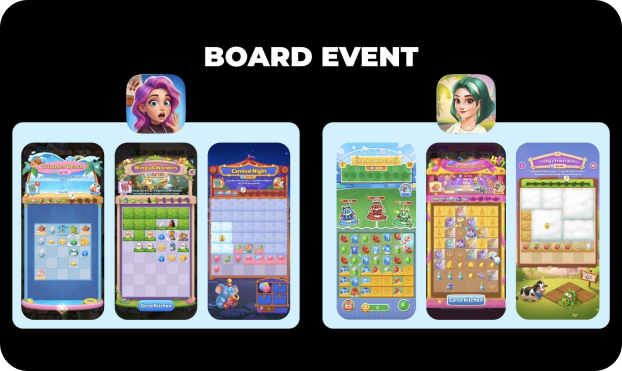
BOARD EVENT
One of the most successful and experience-diverse event formats is the Board Event.
By introducing subtle variations to the familiar core mechanics for a limited period, the format creates a sense of novelty without requiring players to learn an entirely new system.
The concept is particularly effective because it allows players to engage with a new board while leveraging a gameplay loop they already know and enjoy.
Developers that truly excel at live ops build a flexible gameplay infrastructure that can support a wide variety of events, enabling them to build diverse experiences by strategically modifying and recombining existing mechanics, extending the core gameplay while maintaining familiarity and reducing development complexity.
The fact that it is the first short-term event to open indicates its importance.
It diversifies the experience and generates excitement among players by introducing something new every event.
It appears that in the JD, they used the board event from Tasty Travelers.
LEVEL UP
Level-up celebrations drive players' progression and provide them with clear, long-term goals.
Narrative & Art Style
NARRATIVE
In both games, the story is presented through short meta-scenes and comic-style conversations.
These conversations use speech bubbles, character facial expressions, and dramatic images.
I honestly feel like I’m the exact target audience for this, which is probably why I’m absolutely a sucker for it. It just works on me and keeps me hooked and desperate to know what happens next.
What I love most is how it completely immerses me in the characters' world. Even on days when I don’t feel like reading through walls of text, the visual elements do all the heavy lifting and pull me right into the story.
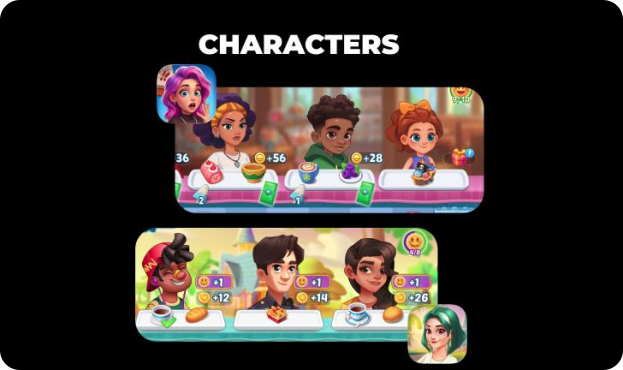
CHARACTERS
In both games, the characters look side to side, breathe, and blink.
Sometimes they even show emotions like boredom or slight annoyance, which makes the game feel more realistic.
SPLASH SCREEN
In both titles, the logo incorporates a two-color palette.
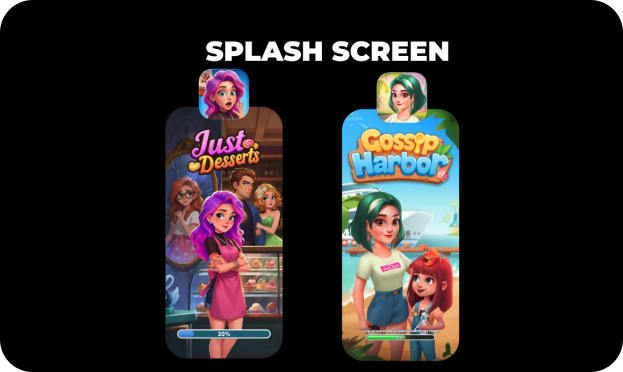
The JD screen delivers a strong narrative focus, generating engagement, excitement, and a sense of drama that foreshadows the storyline.
Conversely, the Gossip screen adopts a more understated approach, featuring only the two main characters.
INTRO VIDEO
JD:
The story is about a single mother whose husband kicked her out of the house while she was pregnant. Just like in other popular games, a tragedy occurs: a fire breaks out at her mother’s bakery.
Her mother dies in the fire. It turns out that her husband started the fire on purpose.
Now, she is determined to get revenge for her mother’s death… How about that for a hook!
We Haven’t Seen the Last Desert Merged Yet
So, will Just Desserts serve up the sweet victory Century Games is baking it up to be, or will Gossip Harbor continue to eat everyone’s lunch? Only time — and a whole lot of Energy tapping — will tell.
What is certain, though, is that the Merge 2 recipe is more addictive than ever, blending tactical progression, compelling narratives, smart monetization, and a core loop that always makes the next goal feel just within reach.
And when casual giants like Royal Match, Coin Master, and Homescapes bring Merge into their LiveOps, it’s clear the genre’s influence extends far beyond its own category. Everyone wants a piece of the Merge action.
I’ll be keeping a close eye on how this new competitor evolves, and what it can tell us about where the genre is heading next.
Follow along for more in-depth breakdowns of the games, mechanics, and trends shaping the casual market.
And in the meantime… I’ll probably be doing just one more merge. 😉
