
Pixel Flow and the Rise of Sort Puzzles
We’re excited to launch Puzzle Monthly!! A new podcast all about puzzle games and the people building them.
We dive into Pixel Flow, one of the biggest puzzle hits and the wave of sort puzzles. We talk about how Pixel Flow scaled so quickly, why its design works so well for monetization, and why clones are already popping up across the market.
💪🏻 Our Crew: Tom Storr, Aylin Yazıcı, Ahmetcan Demirel , David Nelson
Listen to the full conversation on the Deconstructor of Fun podcast.
Pixel Flow Wasn’t an Overnight Success. It Was a Puzzle Studio Finally Getting Paid for What It Already Knew.
Let’s start with the lazy version of the story, because it’s the one people want to tell.
A tiny Turkish team makes Pixel Flow. The game explodes. Scopely acquires it. Everyone points at the chart, says “wow,” and then pretends this was some six-month miracle produced out of nowhere.
What Scopely bought was not just a breakout game. They bought a team that had already done the reps. Before Pixel Flow, this team had already built Twisted Tangle, one of the biggest titles in Rollic’s puzzle portfolio by both downloads and IAP revenue. That matters because it changes the interpretation entirely. This is not a random hit. It is a team that already knew how to build puzzle products, already knew how the market works, and then found the mechanic-packaging-monetization combination that let that capability compound.
That distinction matters because the industry is still addicted to the myth of overnight success. We do this every time. A game breaks out and people immediately focus on the surface novelty. They look for the magic ingredient. A conveyor. A tray. A visual target. A monetization twist. A lucky timing window. Usually it’s some combination of all of those. But underneath that, there is almost always a team that has already spent years learning the category.
Pixel Flow looks sudden from the outside because success always looks sudden once the graph turns vertical.
From Ads to IAP: The Shift Wasn’t Just Business Model. It Was Product Design.
One of the most interesting tensions in the conversation was around Twisted Tangle versus Pixel Flow.
On paper, the story is simple. Twisted Tangle was much more ad-driven. Pixel Flow is much more IAP-heavy. So you could tell a market-timing story: when Twisted Tangle was built, hybrid-casual puzzle was earlier, the lines between hyper-casual, hybrid-casual, and casual were blurrier, and ad-heavy monetization was still a more natural default. There’s truth in that. Market conditions changed. CPI changed. Best practice changed. Studios became more intentional about building for longer-term IAP economics instead of relying so heavily on ad monetization.
But I don’t think that explanation is enough.
David’s point is the more important one: some puzzle structures simply lend themselves to purchases better than others. That sounds obvious until you realize how often the market ignores it. People talk about monetization as if it sits on top of the game. Add a pass. Add a bundle. Add more live ops. Add more economy. But in puzzle especially, the monetization moment is inseparable from the emotional structure of failure.
Match-3 works because the fail state feels recoverable. You almost won. You feel unlucky, not stupid. Spending to continue feels acceptable.
Twisted Tangle, by contrast, is more frustrating in a deeper way. It becomes very “puzzly.” You are trying to solve something, not just progress through it. And when that kind of puzzle collapses, the emotion is different. Buying your way through it does not feel as elegant. It feels more like escaping a mess than extending momentum. Pixel Flow, on the other hand, creates a much cleaner “I messed that up, I’d rather continue than replay” purchase moment. That is not just monetization design. That is game design.
I think too many teams still underestimate this.
The question isn’t “how do we monetize our puzzle better?” The question is “what kind of puzzle failure creates a monetizable emotion?”
Those are not the same question.
The Tray Is the Real Product Innovation
There are a lot of reasons Pixel Flow works. The visual presentation is strong. The targets are readable. The levels are UA-friendly. The game has enough novelty to stand out while still being legible enough to scale.
But the design point I keep coming back to is the tray.
Tom’s framing is exactly right: in a lot of adjacent puzzle games, the tray is technically the fail state, but not psychologically the center of play. It sits there in the background until suddenly it punishes you. That creates frustration, not strategy. You fail and think, great, I forgot about the tray again.
Pixel Flow flips that. The tray is not a background penalty. It is part of your active planning. You are managing it constantly. That one design choice changes a lot. It makes failure feel less arbitrary. It makes success feel more skillful. And crucially, it makes the continue economy feel less cheap. When you buy more room, you are not correcting for something the game hid from you. You are extending a system you were already consciously managing.
That is a big difference.
This is also why “just clone the mechanic” is a weaker thesis than people think. Yes, the surface is clonable. The levels are visible. The core loop is legible. You can absolutely build copies, and some already seem to be making meaningful revenue. But there is a difference between copying the visible system and reproducing the exact way it balances tension, speed, readability, satisfaction, and monetization.
A lot of clones will get installs.
Far fewer will build a durable business.
UA Didn’t Support the Hit. UA Was Part of the Product
Another thing the market tends to do after a breakout is separate product and UA too cleanly. The product was great, and then UA scaled it. Or the UA was amazing, and that’s why the game won.
Pixel Flow’s UA seems to work because the game is inherently creative-friendly. Distinctive artwork-shaped targets are not just a cute design decision. They are a user acquisition weapon. A random level is forgettable. A level shaped like an emoji, a planet, or some other instantly legible visual object is not. It pops immediately in a feed. It communicates the game in a fraction of a second. It also gives you a huge amount of creative variation without needing to fake the product.
Too much mobile UA still depends on the gap between the ad and the game. Pixel Flow seems to have benefited from shrinking that gap. The level target that catches your eye in the ad is also genuinely part of the product experience. That means you get volume, diversity, lower disappointment, and faster creative production all at once. There’s also massive creative output, which would be entirely consistent with how these games now scale. High-volume creative production is no longer a bonus. It is table stakes
And then there’s the conveyor.
I think Ahmetcan’s point here is one the market should take seriously. Conveyor-based motion adds dynamism to gameplay, but it also adds dynamism to creatives. Moving objects generally perform better than static arrangements because they make the ad feel alive. So when you combine artwork-based level targets with a conveyor-centered system, you get something unusually strong: a mechanic that helps retention and monetization while also making UA easier. That’s a very good place to be.
This is why “great product” versus “great UA” is the wrong debate.
The best hybrid-casual winners are designing for both simultaneously.
Can Pixel Flow Be Cloned? Yes. Can It Be Cloned Sustainably? That’s Harder.
My view here is pretty simple.
Yes, Pixel Flow can be cloned. In fact, it already is being cloned. Some of those copies are making real money. If you moved quickly enough and had the conviction early, there was probably money to be made. Clones are already reaching meaningful daily revenue. So the idea that this is some untouchable, unrepeatable singularity is clearly false.
But sustainable is doing a lot of work in that sentence.
A clone does not compete with the original in a vacuum. It competes against a game that already has the audience, already has momentum, already has operational learning, and now sits inside a much larger machine. Once Scopely enters the picture, the equation changes even more. At that point you are not just cloning a mechanic. You are trying to go to war with a better-capitalized operator that can likely outspend you, out-iterate you, and erase your margin if it decides to.
This is why clone discourse in mobile games is often too shallow.
People fixate on “can it be copied?” Of course it can. Almost everything can.
The real question is:
Can you survive worsening CPIs, weaker retention, lower product quality, live ops pressure, and an incumbent that now has both the original learning curve and a serious operator behind it?
That answer is much less comfortable.
What Comes Next Probably Won’t Look Like “Another Pixel Flow”
The most useful part of these conversations is not predicting the exact next hit. Nobody credible can do that with confidence, and the ones who pretend they can are usually just backfilling certainty after the fact.
But you can still look for patterns.
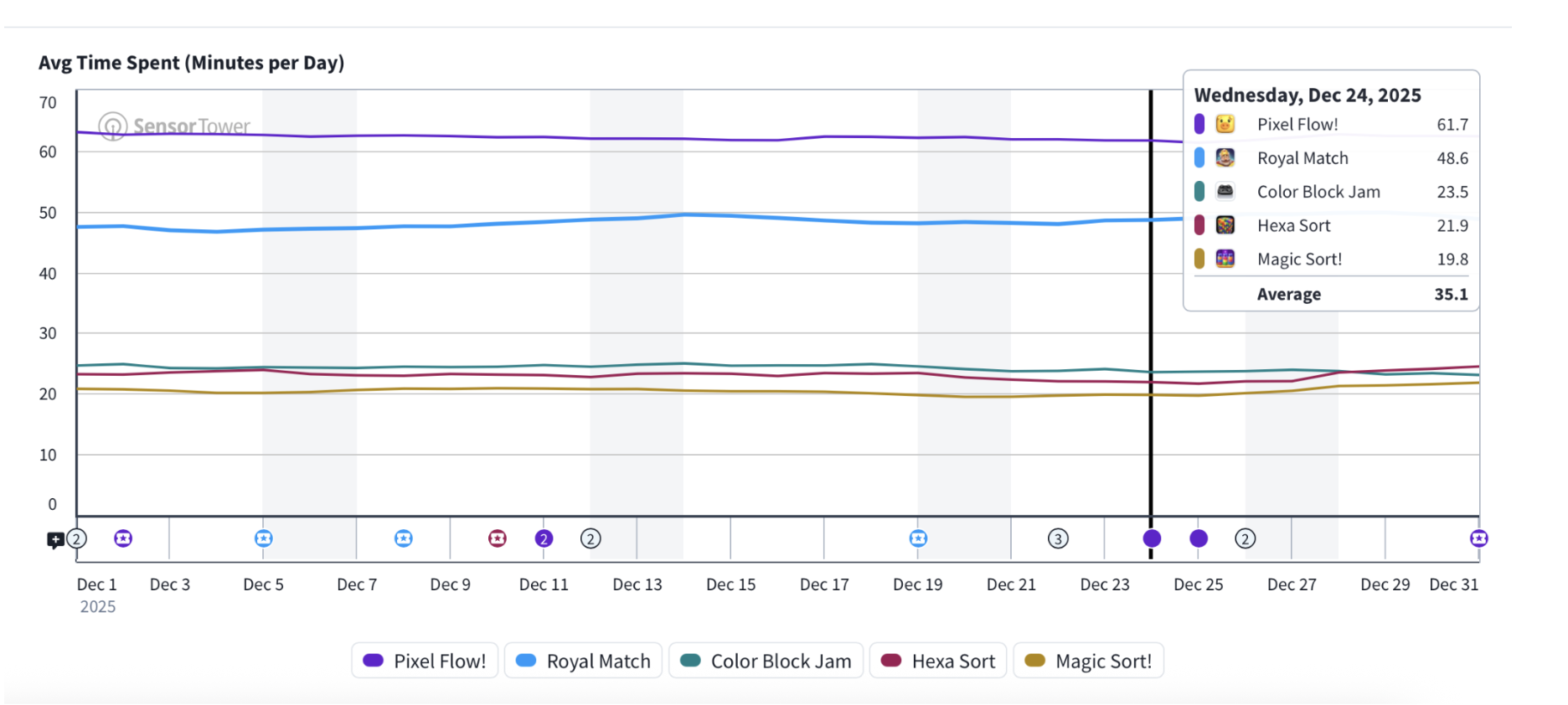
Hexa Sort mattered because it expanded what the category thought a sort puzzle could be. It didn’t just succeed commercially. It changed expectations. It showed how much satisfaction, visual payoff, and low-friction engagement a sort-based structure could deliver. Magic Sort then proved that you could take a familiar core and build a very polished, more mature business around it. Pixel Flow did something slightly different again: it took a known type of interaction and found a version of it that monetized much harder, scaled hard on UA, and crossed from hybrid-casual into something closer to a mainstream casual business.
That suggests the next breakout probably does not come from inventing a completely alien mechanic.
It probably comes from recombining known successful elements more intelligently than everyone else.
I’m already seeing games mix Pixel Flow-style smart systems with other mechanics, whether that’s arrow logic, escape logic, or adjacent puzzle structures. That direction makes sense to me. The next hit will likely borrow the lessons Pixel Flow made obvious, but not stop at copying Pixel Flow. It will take one or two of the things that clearly work, maybe the conveyor, maybe the visual target logic, maybe the high-skill stacking rhythm, and fuse them with another mechanic that already has proven demand.
In other words, the next winner probably won’t be “Pixel Flow but cheaper.”
It will be “Pixel Flow taught us what the market responds to, now here is a cleaner or more scalable variation.”
Why Big Puzzle Companies May Still Miss This
We also had a useful discussion about whether bigger traditional puzzle companies should be worried, or whether they can simply move into this space whenever they choose.
In theory, yes, they can.
The irony is that hybrid-casual puzzle is not some alien strategy to companies like King. David makes a strong point here: if you zoom out, the core idea, take a strong puzzle mechanic and wrap it with progression, monetization, and broader appeal, is not new at all. That is basically old casual puzzle logic. The capability is not conceptually beyond them.
The real problem is organizational.
Smaller studios get good at this because they are constantly testing puzzle concepts, iterating, killing ideas, learning quickly, and making ugly bets. Larger companies are usually optimized for a very different mode of operation. They protect large existing businesses. They move more slowly. Their tolerance for messy experimentation is lower. Their opportunity cost is higher. And culturally, the kinds of people who thrive in those environments are often not the same people who thrive in the “launch ten weird puzzle things and see what breaks through” environment.
So yes, the large companies could do it. That doesn’t mean they will.
The One Thing I’d Take Away From Pixel Flow
If I had to reduce all of this to one useful takeaway, it would be this:
Pixel Flow won because several things that are usually treated as separate were actually designed together.
The gameplay and the monetization logic were aligned.
The visual system and the UA system were aligned.
The puzzle tension and the spend moment were aligned.
The product novelty and the ad readability were aligned.
That is the part people should pay attention to.
Too many teams are still building in sequence. First build the mechanic. Then figure out the monetization. Then let the UA team try to make it marketable. Then patch the economy. Then fix retention. The Pixel Flow story, at least as I read it, looks much more like a team that understood these things were part of one system.
That doesn’t make it easy to replicate. It makes it harder.
Because once you understand that the success came from system fit rather than one clever mechanic, you also understand why the obvious clones won’t automatically become the next great business.
And that is the honest version of the story.
