
Does Merge-2 Monetize Better Than Match-3?
Written by Aylin Yazıcı, Mobile Game Consultant with a soft spot for puzzle-heavy systems.
Want Deconstructor of Fun to help you? Reach out to our capable consulting team.
In February 2026, Gossip Harbor earned $77.7 million, just enough to pass Candy Crush Saga's $71.7 million for the month. By the end of Q1, Gossip Harbor's quarterly revenue had grown 172% year-over-year, while Candy Crush's had fallen 7%.
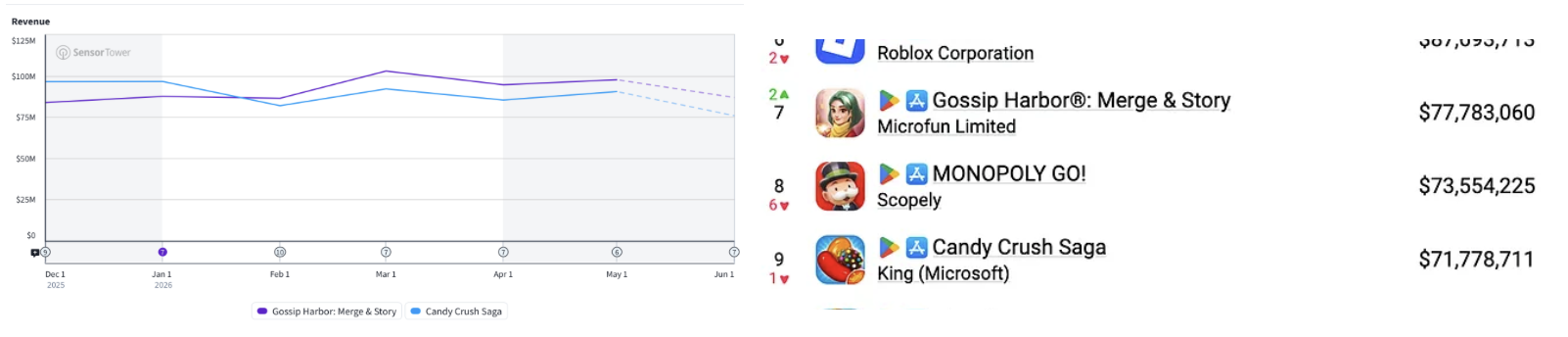
A merge game had quietly overtaken the most recognizable name in mobile puzzles. It sparked a familiar discussion across the mobile games industry. Had Merge-2 discovered a fundamentally stronger monetization model than Match-3, or was this simply another successful game riding exceptional LiveOps?
I started where most people would: the numbers. Revenue, retention, and ARPDAU all pointed in the same direction. Merge was generating remarkable businesses, but the numbers weren't the interesting part. What I really wanted to understand was why spending in Merge games felt so different as a player.
My first explanation was that Match-3 monetizes through failed levels, while Merge monetizes through energy. But energy systems have existed in mobile games for well over a decade. If energy were the innovation, Merge would have become a huge genre years ago. What changed my mind wasn't another chart; it was the board.
Once I started paying attention to how a Merge board actually works, and how differently I behaved while playing on it, I realized I had been asking the wrong question all along. The biggest difference between these genres isn't a monetization mechanic. It's the type of game the board allows them to become. Before talking about monetization, it's worth understanding that board first.
Two Boards, Two Different Games
Although Match-3 and Merge-2 are both puzzle games, they ask players to interact with their boards in completely different ways.
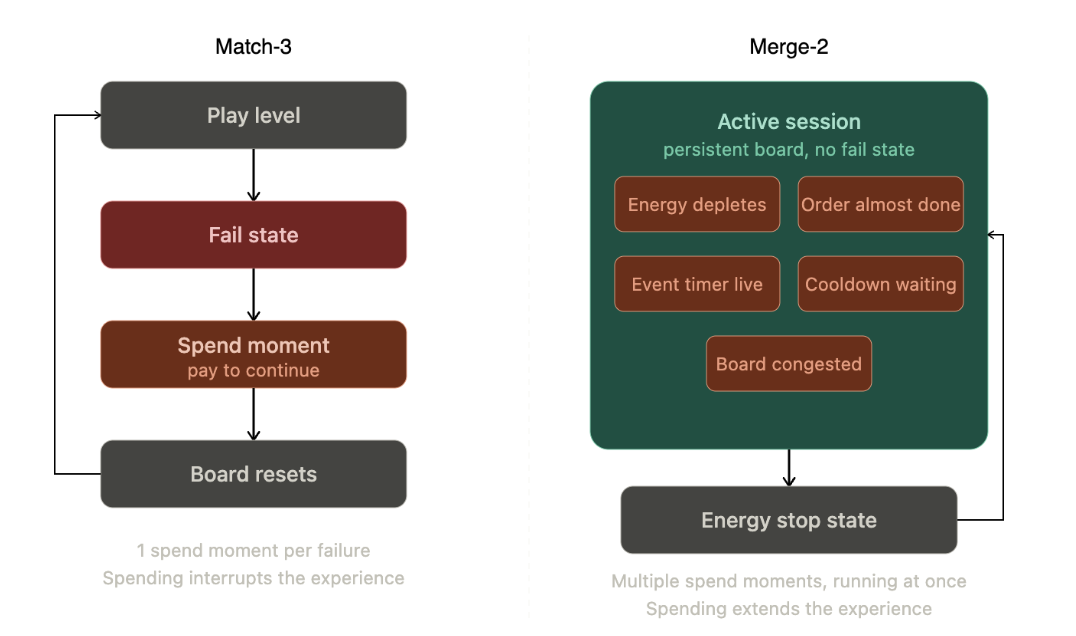
A Match-3 board is temporary. Every level begins with a predefined layout, a clear objective, and a limited number of moves. Whether you win or lose, that board disappears. The next level starts from scratch with a completely different puzzle.
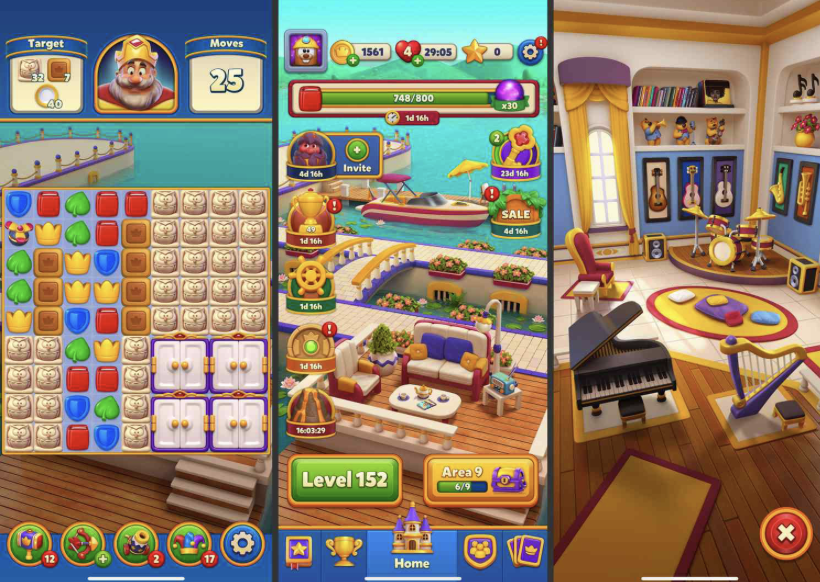
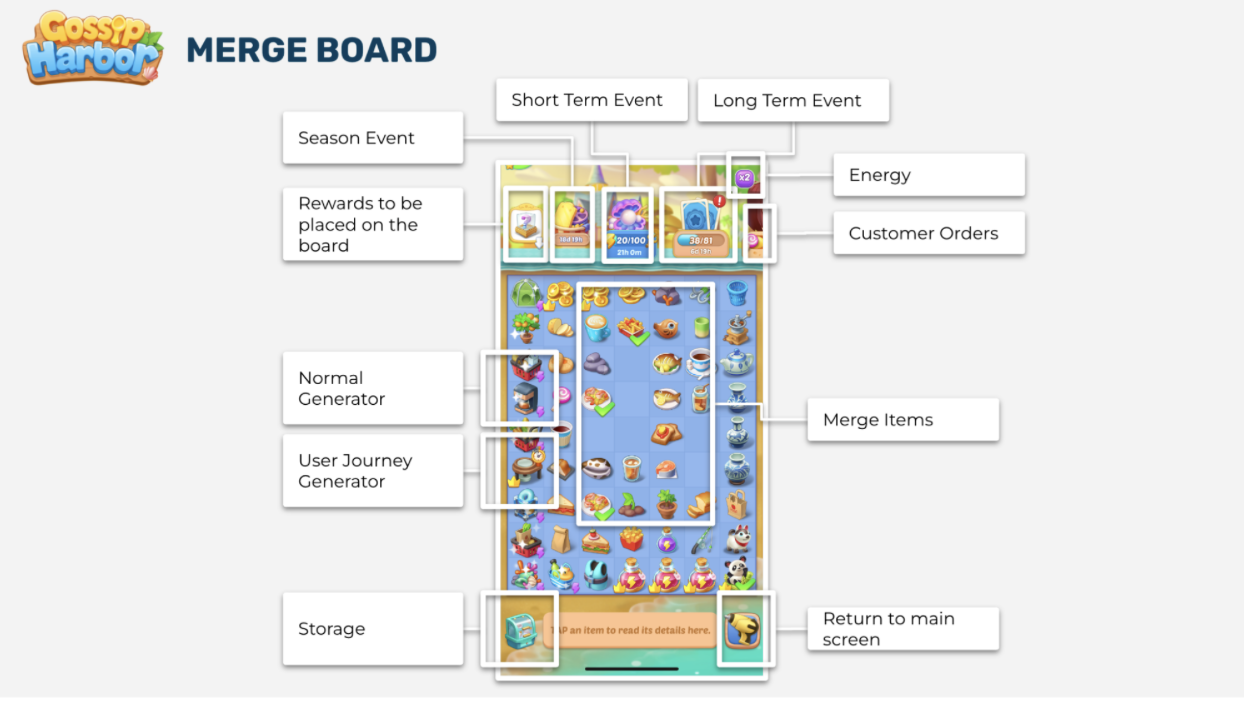
Merge works differently. Instead of moving from level to level, you stay on the same board.. You tap generators to create basic items, merge identical items into higher-level versions, and use those items to fulfill customer orders. Every tap costs energy. Once you run out of energy, you either wait for it to refill or spend to continue. More importantly, nothing disappears. When you close the game, your unfinished orders are still there. Your generators are still waiting to recharge. Half-completed merge chains are exactly where you left them. The next session doesn't begin with a new puzzle. It begins exactly where the previous one ended.
The first thing I noticed with Gossip Harbor was that I stopped thinking in sessions. When I closed Royal Match, I felt finished. Maybe I'd beaten three levels, maybe I'd failed one, but I could comfortably stop playing.
Gossip Harbor didn't give me that feeling. I'd close the game knowing there was still a seafood order waiting for one more shell, or an event ending in a few hours that I hadn't prepared for. Sometimes that made me excited to come back. Other times, it honestly made me feel a little overwhelmed because I knew there was still work waiting for me.
That was the moment I realized I had been looking at Merge the wrong way. I kept comparing it to Match-3 because both are puzzle games. But after playing them back to back, I don't think Merge's core loop is really about solving puzzles. The puzzle is just the interface. What you're actually managing is an economy.
Observation One: Match-3 Sells Solutions. Merge Sells Continuity.
The first time I bought extra moves in a Match-3 game, I knew exactly what I was paying for.
I had almost finished the level. The remaining objective was right in front of me, and I could already picture how those five extra moves would solve the problem. If I bought them, I would either win or lose within the next minute. The decision was simple.
Buying energy in Merge never felt that clean. One evening in Gossip Harbor, I had almost finished a customer order. I only needed one more high-level shell, but the generator had run out of charges. At the same time, there was a timed event ending later that evening, and finishing that order would also progress the event. When my energy hit zero, I didn't feel like I had failed; I felt interrupted.
In Royal Match, the question is usually: "Is solving this level worth paying for?" In Gossip Harbor, the question became: "Is everything I've already built worth keeping moving?"
The purchase isn't really about buying energy. It's about protecting momentum. The more I played Merge games, the less I felt like I was paying to overcome a difficult moment. I felt like I was paying because I didn't want everything I had already set in motion to sit still.
Here's the part I had to sit with for a while to actually understand. Failing and pausing should, in theory, feel similar. Both stop you. Both mean you can't keep playing right now. But a failed level has an edge to it. It's a clean break. The level is over, the door is shut, and whatever I do next is a fresh decision with nothing attached to it.
Running out of energy doesn't shut a door. It just leaves it open and asks me to wait. The order is still sitting there unfinished. The event timer is still running. Nothing about my situation has been resolved; it's just been delayed. And a delay is a much harder thing to walk away from than a loss, because a loss gives you permission to stop thinking about it. A delay doesn't. I'm not deciding whether to try again. I'm deciding whether to keep doing the thing I was already doing, which is a much easier yes.
That's why I think it’s a smarter mechanic than a fail state. Failing gives the player an exit. Pausing doesn't.
Observation Two: The More I Played, the Less I Thought About Puzzles
At first, I thought I was getting better at Merge. After a while, I realized I wasn't. I wasn't becoming faster at merging items together. I wasn't discovering clever techniques or developing better puzzle-solving skills. What changed instead was how I planned.
I started saving energy because I knew an event was about to begin. I delayed completing customer orders until they would count toward multiple objectives. I kept high-level items on my board even when they weren't immediately useful because I knew I'd probably need them later. Sometimes I'd even spend several minutes reorganizing the board before making another merge because finding items had become harder than creating them.
None of those habits made me better at solving puzzles. They made me better at managing a system. That's why I no longer think Merge's biggest innovation is the merge mechanic itself. The merge mechanic is actually quite simple. What's interesting is everything that grows around it. Over time, the game quietly teaches you to think less about the next merge and more about the consequences of every decision you make. A customer order isn't just a customer order anymore. Completing it might progress an event, free up valuable board space, unlock another production chain, or simply make tomorrow's session easier.
Looking back, I think that's the biggest difference between these genres. Match-3 asks players to master encounters. Merge asks players to manage consequences.
Observation Three: Match-3 Runs Out of Things to Sell You. Merge Never Does.
A Match-3 session is naturally self-limiting. I can only fail so many levels in twenty minutes. Once I've cleared the levels in front of me, there's nothing left in that sitting for the game to sell me, no matter how much I'm willing to spend. Eventually, the game has to wait for me to come back tomorrow.
Merge doesn't have that ceiling. If I want to, I can refill my energy five times in a row and keep tapping generators as fast as I can pay for it. Travel Town and Gossip Harbor both sell boosted generators that burn through more energy per tap in exchange for higher-tier items instantly. The faster I spend my energy, the faster I can justify buying more of it. There's no built-in stopping point.
That's the part that changed how I think about this comparison. Match-3 can run out of selling opportunities quickly, on purpose, because a level is supposed to feel finishable. Merge is designed so the selling opportunity never actually runs out, because the board itself never finishes. One genre is built to end your session. The other is built to let you keep going for as long as your energy and your wallet hold out.
Why This Is Happening Now, Not Ten Years Ago
Energy systems aren't new, so it's worth asking why Merge is having this moment now instead of a decade ago, when Facebook games were already running on the same basic mechanic.
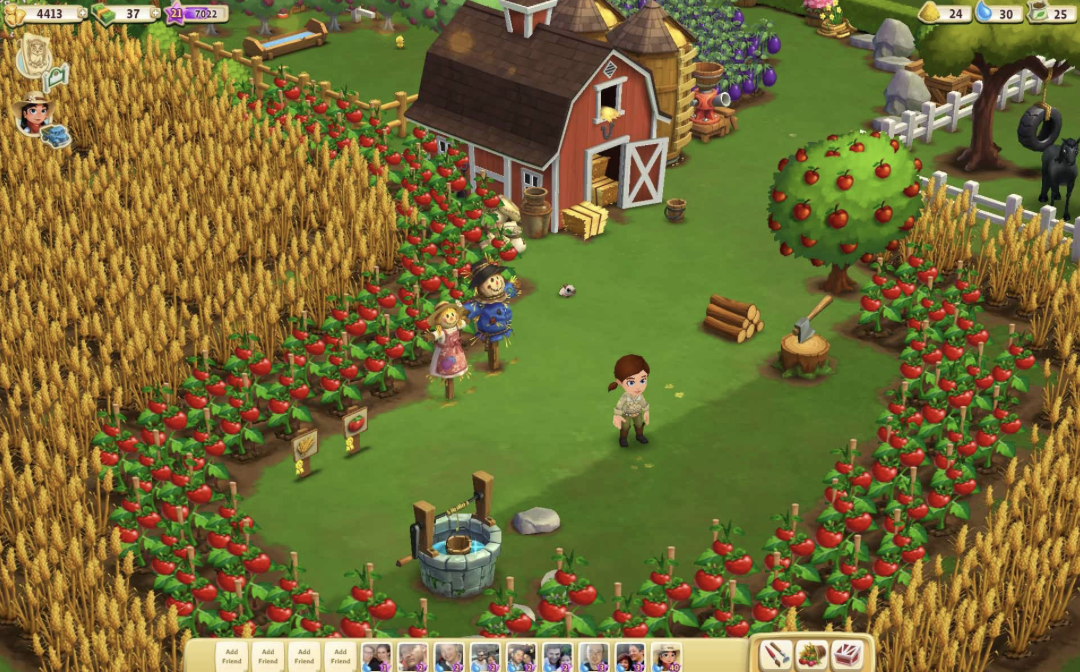
Game: Farmille. Every basic action (clearing a tree, planting a plot, feeding an animal) consumed a set amount of energy.
Part of the answer is mechanical. The version of energy that powers Gossip Harbor and Travel Town today isn't the same thing that gated old social games. Boosted generators, which let a player burn through more energy per tap in exchange for higher-tier items, only became standard across the genre around 2023. Before that, energy was just a limiter. Now it's something a player can actively choose to spend faster, which is what actually removes the spending ceiling I described above. That's a recent design change.
The other part of the answer is about who's funding the genre. Gossip Harbor's publisher, Microfun, is a Chinese studio with the user acquisition budget and targeting sophistication to compete directly with Match-3's biggest names.
So Merge didn't wait ten years to get good. It waited for its core mechanic to mature and for someone with the budget to push it in front of the right audience at the same time.
Where Match-3 Still Has the Advantage
If this article ended by declaring Merge-2 the superior monetization model, it would oversimplify what makes both genres successful. Royal Match is a useful reminder of that. It still earns more in total revenue than any Merge game today, because it has a much bigger audience and is one of the highest-grossing mobile games in the world.
The longer I compared them, the more I appreciated what Match-3 still does better. Its greatest strength is clarity. Every level has a clear objective, a predictable duration, and an obvious definition of success. Players always know what they are trying to accomplish, why they failed, and what they need to do next. That simplicity is what lets it scale to an enormous audience, including players who would probably find a Merge board confusing on day one.
Merge games trade some of that clarity for depth. As the economy grows, so does its complexity. Boards become crowded, production chains become harder to track, and players must constantly prioritize between competing objectives. Those decisions make the economy richer, but they also increase cognitive load. That trade-off is real, not a footnote.
Merge hasn't replaced Match-3 because it is objectively better. It has succeeded because it solves a different design problem.
Match-3 Has a Bigger Problem Than Losing This Comparison
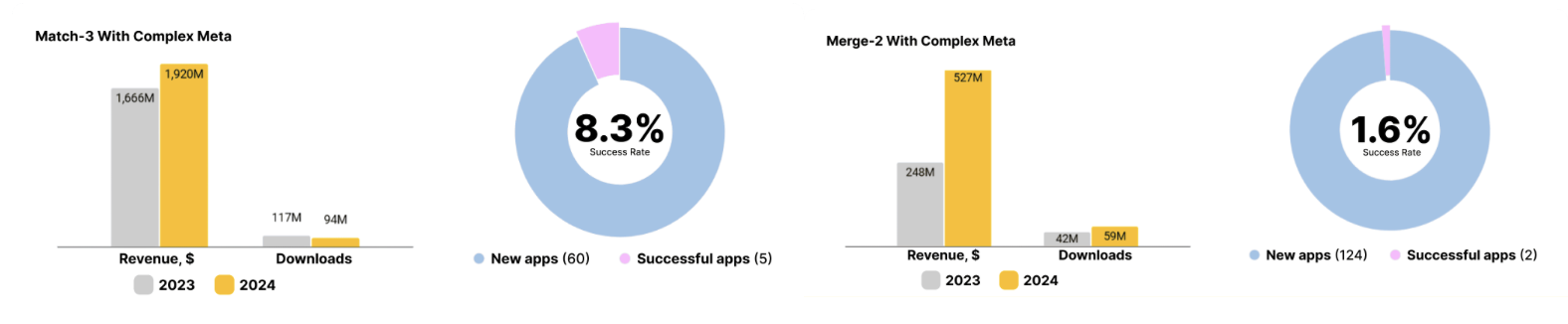
There's one more thing worth saying plainly. Match-3's lead in total revenue is real today, but the genre isn't growing the way it used to. Several long-running match-3 subgenres lost both revenue and downloads in 2025, while Merge-2 grew 80% year-over-year in the same period. Match-3 isn't shrinking, but it's not finding new ground either. It's defending what it already has.
Merge doesn't have that ceiling yet. It's still a smaller business in total dollars, but it's the one still climbing. If that trend holds, "Match-3 earns more overall" is a true statement about right now, but it may not be a guarantee in a couple of years.
So, Does Merge-2 Monetize Better Than Match-3?
Merge earns more per player. Match-3 still earns more in total, because it has a far bigger audience. So the honest answer isn't yes or no. The two genres are extracting value in different ways, and one of those ways scales better per person while the other scales better across more people.
What actually changed my mind is that Match-3 sells you a way out of a problem, while Merge sells you a way to keep going on something you already started. That difference changes how much a player can spend, how often the game can ask for it, and how natural that asking feels in the moment.
I think that's the real story here, more than any individual mechanic. Merge didn't out-design Match-3. It built a different relationship with the player, one where nothing ever really ends, so there's always something worth paying to keep moving.
