Discord’s Growth Pitch to Game Studios: What’s Proven and What to Ask For
Discord wants you
By Jen Donahoe, Strategic Marketing Consultant and Deconstructor of Fun co-host
Jen Donahoe's conversation with Jules Shumaker, Chief Business Officer at Discord, on five tools Discord is building for game studios, and why now is the time to strike a deal.
Full conversation with Jules Shumaker: Watch on YouTube · Listen on Spotify
User acquisition for games keeps getting harder. Discord says it has an answer: 90 million daily and 200 million monthly users, more than 90% of whom played a game in the past month, by its own count. Jules Shumaker, Discord's Chief Business Officer, made the case to me on Deconstructor of Fun.
Let me concede the obvious first: Discord is selling. It filed confidentially for an IPO in January, and Nitro subscriptions alone make a thin public-market story. This is also its second run at games. In 2018 it added a games catalog to Nitro, then pulled it a year later because few subscribers played. Discord needs this attempt to work, and it needs studios to prove it. That makes now the time to negotiate, and it's why we're talking about it.
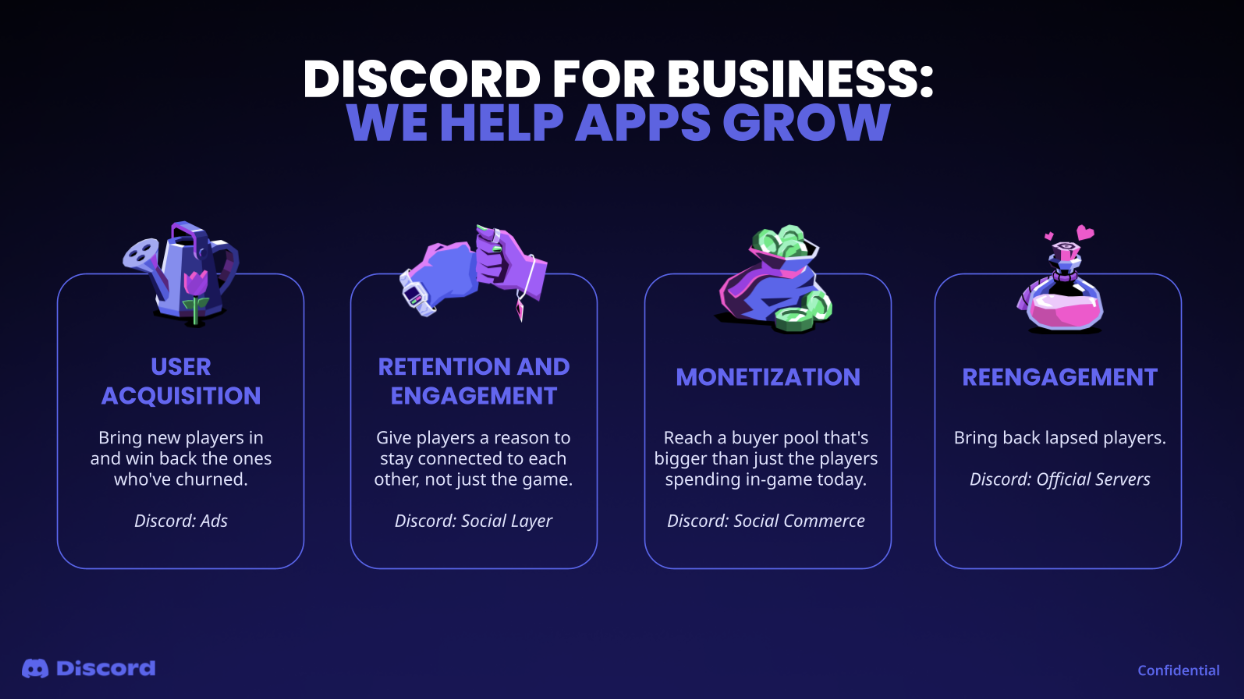
Discord pitches four ways it helps games grow: user acquisition, retention and engagement, monetization, and reengagement. Source: Discord.
Disclosure: Jules and I overlapped at EA and shared a boss, and I've been on Discord since 2017. I'm a fan of both, so weigh my read with that in mind.
1. Your Discord server is a launch asset if you staff it
Jules starts with where players already are. Discord's developer documentation says 66% of its users play games with friends every week, and the anniversary post counted more than 2 billion hours of gaming a month. More than 30% of games that haven't launched yet already have a Discord server, and more than 9,000 official game communities live on the platform with over 80 million members combined.
Claiming your server unlocks a game profile page, and Jules says 48 million users a day find games through player and game profiles. How many of those become installs is the number that matters, and Discord hasn't shared it. Claim the profile anyway, since it's free shelf space, and ask your Discord contact for your own profile's conversion data. Jules is flexible on who runs the server. Riot lets community members own its servers, and she counts that as a strategy in its own right.
If your audience is PC or core, a server before your first playtest is cheap insurance, as long as someone owns moderation from day one. An empty or unmoderated server is worse than none, because players read it as a signal about the game. On casual mobile, check whether your players are on Discord before you staff one.
2. Social players retain better
The Social SDK links a player's Discord friends into your game. Players send invites, jump into a friend's session, and see what friends are playing. There's no license fee, and Discord provides solution architects and developer education. Marvel Rivals and Valorant run it, and Jules named Call of Duty and Battlefield as going live.
Discord's headline number: linked players show a 31% increase in D28 retention and play 1.5 more game days a month than unlinked players. Discord's documentation adds that PC players played a median of 6 times longer when they played with at least one Discord friend.
Very rarely do you have the exact same goal as a partner, and we both do.
— Jules Shumaker
3. Discord knows who stopped playing your game
Reactivation is one of my biggest challenges as a marketer. In the data I've seen, returning players run above the median on almost every metric, especially paying, and they are the hardest group to find.
Discord users choose to share what they're playing so friends can join them. That gives Discord a signal most ad platforms lack: it knows who played your game and stopped. Among campaigns existing games buy on Discord, about half go to finding new players and half to reactivation.
Once you have that player, my goodness, hold onto them.
— Jules Shumaker
Give reactivation its own budget line and a CPA target, and run a lapsed player campaign against a holdout. This is where the IPO timing helps most: ask for test credits and a joint incrementality read. Then ask one more question before you sign. Can a competitor target players who stopped playing your game? If the answer is yes, negotiate an exclusion.
4. Rewarded ads work on Discord's payers, so test them on yours
Discord's ad business runs on opt in, rewarded formats. Quests let players play a game for a few minutes or watch a video, then collect a reward. The suite adds hero takeovers of the Quest page, a performance based Video Quest priced on outcomes like cost per install, and a self serve ad manager so studios of any size can run their own campaigns. Video Quest and the self serve ad manager are brand new, so performance data will take a few quarters to build. New ad products usually come with launch pricing and hands-on support, which lowers the cost of finding out. On mobile, Jules says ad performance runs high while reach is still low.
Discord reports 3x more positive sentiment toward its ads, and players are 71% less likely to skip or be annoyed by them, compared with traditional ads. Discord has not specified the comparison set. Source: Discord internal data, December 31, 2025.
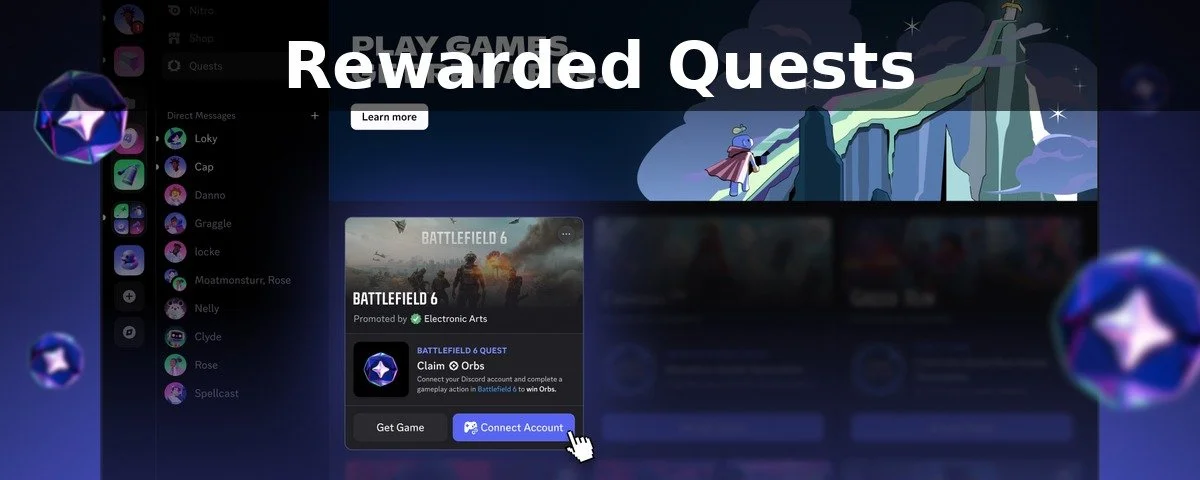
Our payers participate in the ads at a higher rate than our non-payers.
— Jules Shumaker
Every mobile game developer can take that finding and use it right now. There's a lot of data showing players enjoy rewarded ads when they opt in and get something of value for their time, and I pay in most of my games and would happily watch a rewarded video here and there. The one thing to watch is substitution. On Discord the reward is a profile cosmetic, and in your game it's often currency your payers would otherwise buy.
Add rewarded ads and test them on a payer segment, tracking IAP revenue per payer next to ad revenue. When ad revenue adds more than IAP gives up, roll them out to everyone.
5. Social commerce: early signal with a real cost
Discord launched social commerce with Marvel Rivals in December, and 41% of purchases made through it were gifts. That launch landed in peak gifting season, and Discord hasn't shared volumes, so treat it as an early signal.
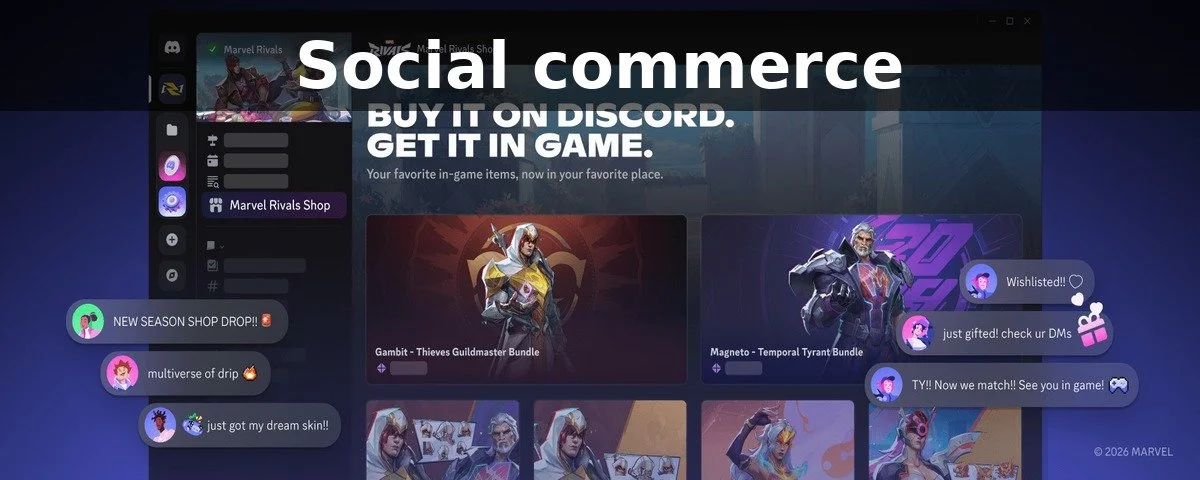
It's a social platform. People see it's your birthday. They know you play Marvel Rivals because you share it on the platform.
— Jules Shumaker
I told Jules this feels like Discord's identity layer, and she liked the framing. Nitro lets players decorate their profiles the way we decorated MySpace and Facebook pages, and gifting borrows from TikTok and other social platforms. Discord measures itself on high frequency users, a useful reminder that your most valuable players include your most engaged ones as well as your biggest spenders, and the two groups overlap.
The newest piece, rolling out to select publishers, is what Jules calls zero take rate commerce. Discord takes no cut, and the developer gives Nitro subscribers a discount. That discount comes out of your margin and makes Nitro more valuable to Discord, so the take rate arrives by another route. Nitro perks are growing as a partnership tool too, starting with the Xbox Game Pass deal.
Compare it to your web shop, where you pay processing fees and keep the customer. Discord needs commerce partners to prove this model, so ask it to share the cost of the discount, and confirm you own the purchase data before you sign.
Discord's second shot at games
Distribution is the biggest challenge in games, especially with AI democratizing development and flooding the market with new games. Discord is one answer worth testing.
When Discord pulled the Nitro catalog in 2019, it learned what its players come for: each other. This time it's selling the social layer around your game, which it does own: it reaches players every day while they choose what to play next with their friends. That's a narrower pitch and a more credible one. Jules says her CFO would call it a flywheel, and you can't leave a conversation in gaming these days without one.
My recommendation: test Discord the way you test every new UA channel. Start it as a test budget inside UA and live ops, with an owner and targets, and give it its own line once it beats your CPA on an incremental basis. Then judge the whole blend. Discord also brings social and organic value that a performance read alone will miss: a community talking before launch, friends pulling friends into your game, and a profile page doing discovery for free. Durable growth comes from brand and performance together.
If you build on PC or console, start with the Social SDK and measure it against a holdout. If you run marketing, put a lapsed player campaign up against your current reactivation cost. If you're on mobile, get into the product conversations while Discord is still listening.
Hold Discord to three proof points over the next year: published case studies with holdout tests, real reach on mobile, and early Video Quest results. Discord needs that proof before it goes public, and only studios can supply it. That gives you a seat at the table, so use it to get the test terms you want.
About Jules: Jules has spent two decades building ad businesses on platforms that didn't have one: in game ads at EA, rewarded ads at Zynga, revenue at Unity as CRO. Discord hired her as Chief Business Officer in early 2025. That hire tells you where Discord is heading.
Related reading
How Game Studios Should Allocate AI Budgets
7 Lessons From Riot CFO Mark Sottosanti, Including How Arcane Season 2 Effectively Broke Even