How Top Studios Should Allocate Their AI Budgets
Where game studios should spend their AI money, why the real bill runs about 30% over plan, and what that means for junior hires. By Michail Katkoff, based on his work with studios around the world.
Founders and execs keep asking me the same questions: how much are other studios spending on AI, and most importantly, on what? After working with studios around the world (and counting the real cost of studio engineering more than once), I’ve concluded the dollar figure matters far less than the allocation. And the honest answer adds up to more than 100%. Let me walk you through.
Start with the gap. McKinsey’s 2026 State of AI surveyed 1,719 people in 97 countries. 80% say AI has made them personally more productive. Only 37% say it has contributed to their company’s EBIT (earnings before interest and taxes), essentially unchanged from a year ago. The high performers are companies attributing at least 5% of EBIT to AI. In other words, Individuals got faster, but the companies didn’t get richer.
Gaming shows the same split. In Unity’s 2026 report, just 5% of developers said they don’t use AI at all. Yet GDC’s 2026 survey found only 36% of developers personally use AI tools, and 52% say generative AI has hurt the industry, up from 30% a year earlier. Studios buy the tools to be used by their people, who don’t trust them. That gap is where studios are burning their AI budgets.
Most studios I see allocate the inverse of what works: the bulk of the budget goes into tool licenses spread across the org, a slice into a vague “innovation” function, and nothing into the boring work of rewiring how things get done. Last year’s McKinsey edition found that fundamental workflow redesign had the strongest correlation with EBIT impact of any attribute tested. Yet only a fifth of companies had done it.
You are not buying tools. You are buying a different way of working. The tools are the cheapest part of that purchase.
One more thing changed this year: AI stopped being priced like software. GitHub moved Copilot to usage-based billing in June. Agentic coding tools bill by the token. Uber burned through its entire 2026 AI budget in just four months and now caps agentic coding spend at $1,500 per engineer per month. Budget AI like cloud: metered, capped, with one owner who looks at it every week. This pricing change has a fundamental impact on budgeting.
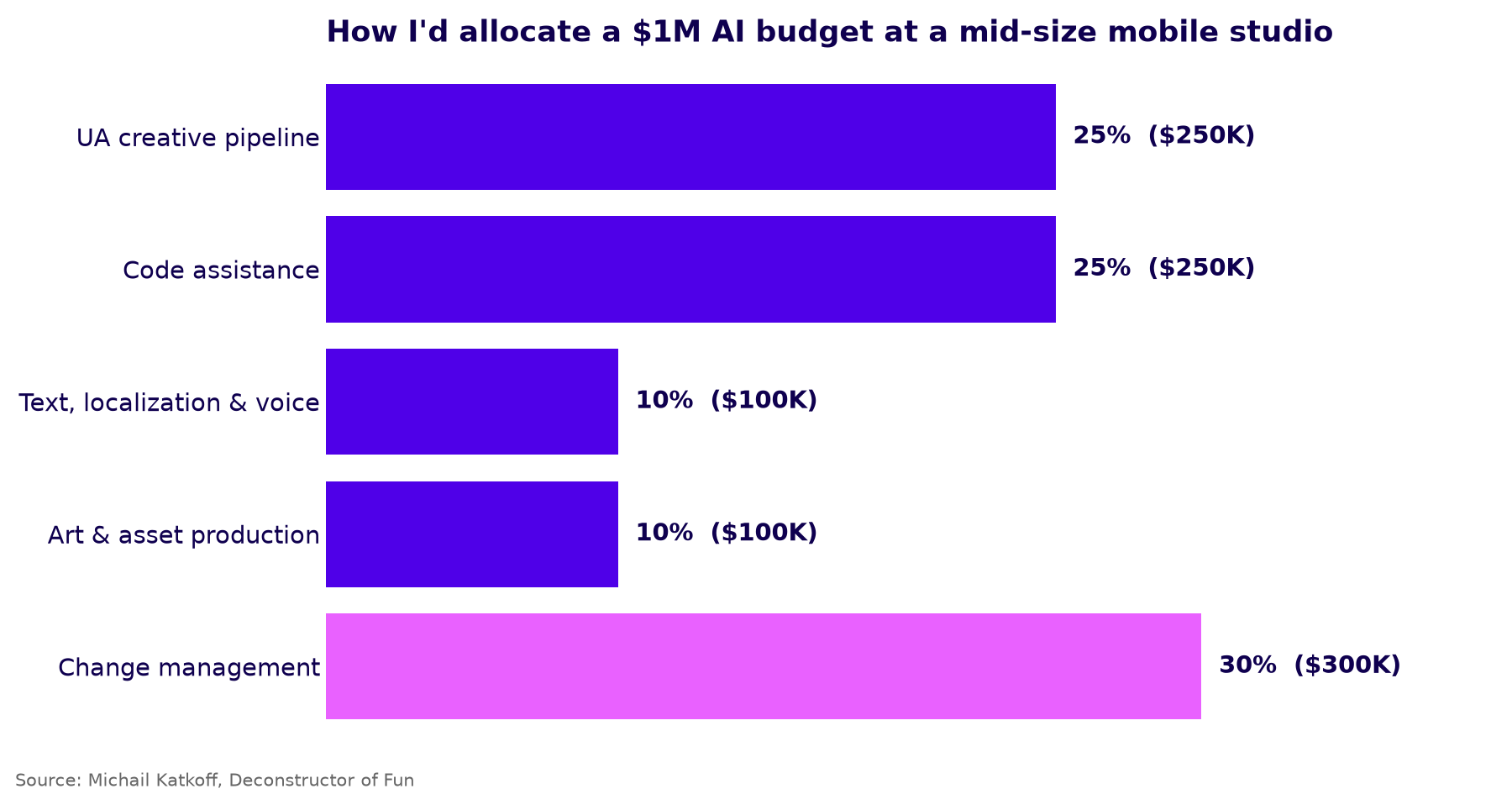
Here is how I would allocate the budget at a mid-size mobile studio today, in order of likely return.
For a $1M annual budget at a mid-size mobile studio:
UA creative pipeline (25%): tools plus the people who run them
Code assistance (25%): seats plus capped token spend
Text, localization and voice (10%): tools plus human QA on every locale
Art and asset production (10%): tools plus the person who stays current
Change management (30%): implementation lead, org-wide training, selected consultants, roadmap time for workflow redesign
1. UA creative pipeline (25%)
This is the most direct P&L line in the stack, and it isn’t close. Playables reached 13.3% of mobile gaming ad impressions in 2026, nearly doubling year over year according to Sensor Tower. The top studios now run some 100 playable concepts a month. The volume math has changed for good.
The reason is structural. Meta’s Andromeda and AppLovin’s Axon reward creative diversity at volume over clever targeting. The machine finds the audience pocket no human would have hypothesized. (More on that in The UA System the Platforms Can’t Build for You and our earlier look at rethinking creative production with AI.) The only thing the human controls is how many distinct shots on goal it gets.
The tools I’d look at: Sett to build the full agentic loop of ideation, generation, testing, and signal feedback. Segwise for creative intelligence, and the only platform I know of that tags playables at the interaction level. Higgsfield and Layer for brand-trained static and video at batch scale. Playablemaker for hand-built playables when a generated one won’t cut it.
If I had a live game and could fund only one AI initiative, this is where the money goes.
2. Code assistance (25%)
Engineers who tried Claude Code early on and hated it should look again. The models are meaningfully better, and they will be meaningfully better again in six months. Greg Kroah-Hartman, the Linux kernel’s other top maintainer, recently said AI-generated bug reports “aren’t slop anymore”, and an experimental review system called Sashiko is catching real issues before they reach human reviewers. If the kernel takes this seriously, your live ops codebase has no excuse.
Be careful with productivity claims, mine included. METR’s 2025 study found experienced developers were 19% slower with AI while believing they were faster. Its February 2026 update says developers are likely sped up now, but it can’t say by how much, because 30 to 50% of invited developers refused to work without AI. That refusal is a data point in itself.
The coding stack I’d recommend: Cursor and GitHub Copilot for daily IDE work. Claude Code and OpenAI’s Codex for agentic refactors and migrations. Greptile or CodeRabbit to catch issues before a human reviewer sees them.
This bucket gets 25%, up from what I’d have said six months ago, because the cost moved from seats to tokens. A heavy agentic user can run $1,000 to $2,000 a month. Cap it per head, review the top spenders monthly, and never put token counts on a leaderboard. Uber did, and the tokens became the KPI.
3. Text, localization, and voice (10%)
Localization, narrative, marketing copy, store descriptions, support macros, patch notes. This is the lowest-risk, highest-velocity category in the stack, and most studios still pay vendors to mark up frontier-model output and return it.
Truth be told, whatever frontier model leads on the day you read this will draft and iterate faster and more consistently than your current vendor pipeline.
For localization, Lokalise and Smartling have built AI workflows on top of the same models. For voice, Inworld has moved from NPC tooling into real-time voice infrastructure, and its text-to-speech now tops the independent leaderboards. Use it for prototyping and placeholder VO. Ship AI voices in a final game and be ready for the backlash Embark took over Arc Raiders.
The catch is QA. Generating text is cheap. But I’d budget for a human in the loop for every locale, just to avoid translations that break my retention curve. Seen that a few times…
4. Art and asset production (10%)
The days when AI was mostly for ideation and concepting are truly over. It’s in full production now, through node-based workflows that demand real craft from the artists running them. Artists (humans) are very much in the loop. They just work differently.
These tools move so fast that any recommendation goes stale within months. As of this writing: Midjourney and Flux for stills. Veo 3.1, Kling 3.0, and ByteDance’s Seedance 2.5 for video, with the Chinese models setting the bar on motion coherence. Krea for art-direction-aware iteration. Scenario for models fine-tuned on your studio’s IP.
What matters more than the tool is one person whose job description includes “stay current on what the models can actually do this month.” Without that person, you will either underuse the technology or, much worse, ship the slop.
5. Change management (30%)
McKinsey’s 2025 survey looked at the few companies actually making money from AI. More than half had rebuilt how their people work, not just added tools. And their leaders were three times more likely to use AI themselves instead of just paying for it.
If the leaders are actively using AI tools, the probability of the AI investments succeeding and being ROI positive are massively higher.
In gaming terms, the studios getting ROI aren’t the ones with the most subscriptions or the most viral hackathons. They’re the ones where the head of UA opens Sett themselves on Monday morning, where the CTO ships with Claude Code in their own branches, and where someone has an explicit, paid mandate to redesign the creative-test-iterate loop end to end.
Concrete example: AppsFlyer paused its OKRs for a full quarter and put 1,300 employees through an AI builder course (their CPO tells the story here). For the same playbook inside a game studio, see how InnoGames kept Sunrise Village alive with AI. That should be the standard. For the full picture, watch Ben Feder on AppsFlyer’s AI transformation.
But change management isn’t only training. It’s managing fear. The GDC numbers above are the mood in most studios. When King reportedly cut roles and replaced them with AI tools its own staff had built, morale was described as “in the gutter.” Krafton went “AI first”, committing roughly $70M to a GPU cluster plus about $21M a year for employee AI enablement, then froze hiring and offered voluntary buyouts. If you skip the people part of change management, you’ll get adoption on paper and resistance in practice.
The uncomfortable part: the budget is bigger than the budget
That’s the plan on paper. In the studios I work with, real AI spend runs closer to $1.25M to $1.3M for every $1M planned. The extra is funded by roles they no longer hire. That’s my observation from client work, not survey data, but I see it consistently.

When a senior engineer with coding agents, or a senior artist with a solid node workflow, covers ground that used to take a small team, there’s simply no logical reasons to hire juniors. And that can cause problems down the line.
Mostly, those are junior roles, and this isn’t only my anecdote. Stanford’s latest payroll data shows employment among 22- to 25-year-olds in highly AI-exposed occupations is now about 19% below where it would be had it kept pace with peers in less-exposed jobs. The change is taking place outside headlines. It runs mainly through reduced hiring. Nobody is firing juniors. They just aren’t opening the positions.
The reason is simple. AI reproduces codified knowledge well. Experienced people run on tacit knowledge built through judgment. How juniors learned was by making simple bug fixes, doing first passes on assets. And it’s exactly what the tools now do. A senior engineer with coding agents, or a senior artist with a solid node workflow, covers ground that used to take a small team. Not every junior role disappears, but far fewer are being opened.
The savings are smaller than the headcount math suggests, though. Seniors cost more, and seniors running agents burn tokens. (We dug into the broken career ladder in What AI Is Really Doing to Games.) You’re moving money from salaries to compute, and handing your seniors more review work. The net saving is real, but thinner than the org chart implies.
Then there’s the bill that arrives later. No juniors today means no seniors in five years. Stanford itself calls its findings early indicators, not proof of cause, and some companies are betting the other way: IBM reportedly tripled its junior intake this year on the view that whoever keeps hiring entry-level talent wins in three to five years. I wouldn’t copy that blindly. But a studio that hires zero juniors could just be borrowing against its own future talent pool.
So my advice for studios: hire fewer juniors, and hire them deliberately. Treat them as apprentices to seniors who work with AI, not as cheap capacity. That’s where the extra 30% comes from, and some of it should go back.
My advice for juniors: be AI-native. Seniors have to unlearn a decade of habits, and you get to start where they’re trying to go. But prove it with shipped work, not prompts. And learn enough of the craft to tell good output from bad. Judgment is what makes you a senior.
Listen to the episode
352. AI Made Every Team Faster. Then It Got Messy. Retrofitting AI into a 1,300-person company and building one around it from day one are different problems. Mishka Katkoff sits down with Liaz Kamper, AI Experience Architect at AppsFlyer, and Maor Cohen, CTO of Vibes, to compare the two. YouTube · Spotify · Apple Podcasts
Related episodes
How to Build an AI-First Culture with 1,300 People (AppsFlyer CPO Barak Witkowski) · article
The Most Honest AI Adoption Story in Gaming (Thomas Lehr, InnoGames) · article
Get the Monday essay before it hits the blog. Deconstructor of Fun breaks down the business of games every week: deep dives, data and the podcast. Subscribe for free