My Wife Deleted Roblox
My wife uninstalled Roblox from our iPads so that our kids wouldn’t play it anymore. Not because something happened, but because Instagram reels and podcasts painted a picture of danger she couldn't disprove.
I didn't have a good counter-argument. So I went looking for one. I invited Matt Kaufman, Roblox's Chief Safety Officer, and Eliza Jacobs, VP of Safety Product, onto the podcast and spent an hour pressure-testing everything the company claims about its safety investments.
Watch/listen to the full episode here
What I found changed my position. Sure, Matt and Eliza gave polished answers. But it was the data behind those answers that made their arguments harder to dismiss than I expected.
The Problem No One Else Wants to Own
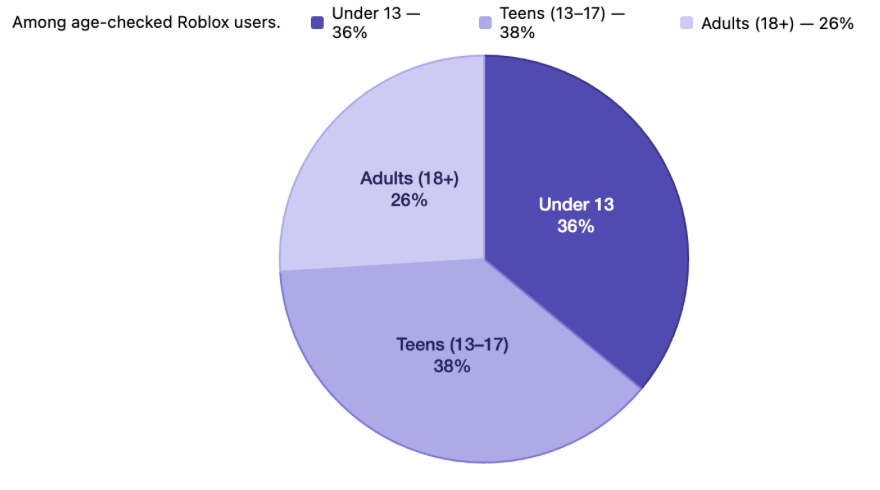
Here is what makes Roblox structurally different from every other major platform: it publicly acknowledges that children use it. Among age-checked users, 36 percent are under 13, 38 percent are teens, and 26 percent are adults. That is not the "kids' platform" people assume. It is roughly a third kids, a third teens, a third adults, with the adult segment growing fastest. And yet Roblox chose to build its entire safety infrastructure around the youngest and arguably most vulnerable cohort.
Instagram, Snap, TikTok, YouTube, and Discord all hide behind age gates that nobody enforces. Roblox went the other direction. As Matt Kaufman put it during our conversation: "Roblox is the only large platform in the world that is super transparent about the fact that there are kids and teens on the platform."
That transparency is both courageous and commercially dangerous. The moment you admit children are present, you own every failure. When a predator makes contact, when inappropriate content surfaces for 30 minutes before moderation catches it, when a username references a convicted criminal, the scrutiny hits Roblox first. Not the platforms where the actual harm migrates to. Not the social media apps where the outrage videos get millions of views, on platforms that never ask how old their own users are.
This asymmetry is real and it costs them. Whether that bet pays off will determine if the company survives its next decade or becomes the cautionary tale parents already assume it is.
What the Safety Stack Actually Looks Like
The investments Roblox has made go well beyond what most people, including most industry professionals, understand.
Start with Facial Age Estimation, which they call Age Check. Launched globally in January 2025, it requires users to use their device camera, where they turn their head to the left, then to the right, to complete the age check before accessing communication features. The system checks liveness (real person, not a photo), then estimates age from facial structure with a margin of error of roughly plus or minus 1.4 years for users under 25. Tens of millions of users have already completed the process. No other platform has deployed age verification at this scale as a proactive gate.
Then layer in the communication architecture. Roblox does not allow image or video sharing in chat. There is no encryption. All communication is monitored and filtered. Users can only chat with peers in their own age bracket and similar groups. Children under nine have no access to chat by default, and a parent must actively opt in through linked parental controls to change that. Reason being that Roblox has several filters and blocks on Trusted Connections messages, since they're people you know IRL, like parents or classmates, but they don't monitor in the same way as general messages.
The company built a proprietary ML model that detects grooming conversations, called Sentinel, and then open-sourced it to the broader industry so competitors could use it too. In the first half of 2025 alone, the system helped generate roughly 1,200 reports of potential child exploitation submitted to the National Center for Missing and Exploited Children. Underneath all of this sits AI moderation processing more than 4 billion text messages a day and millions of hours of voice content. No platform is operating at that volume with as heightened standards.
On the content side, every asset uploaded to Roblox goes through moderation. But as Eliza Jacobs, VP of Safety Product, explained, moderation on a UGC platform is fundamentally different from moderating a feed of static videos: "We moderate every asset as it's uploaded. But then those assets get combined into games. Well, now we have to look at it again in combination. And then we moderate the accuracy of the rating. And then we see how people are actually playing the game."
This is the core challenge. A game that looks clean in review can evolve once players interact with it. Roblox built what they call RM3, real-time multimodal moderation, a system that takes snapshots of live servers to analyze actual player behavior, not just developer intent. It is an acknowledgment that static moderation cannot secure a dynamic platform.
And then there is the cross-platform problem. Predators are not stupid. They use Roblox's social graph to identify targets, then move conversations to platforms such as Discord or Snapchat. Roblox's response involves strict filters against sharing handles, phone numbers, and off-platform invitations, but also behavioral detection. When the system flags attempts to direct users off-platform, it triggers investigation by a team of former law enforcement professionals who proactively engage with local authorities.
The Business Logic Behind the Safety Spend
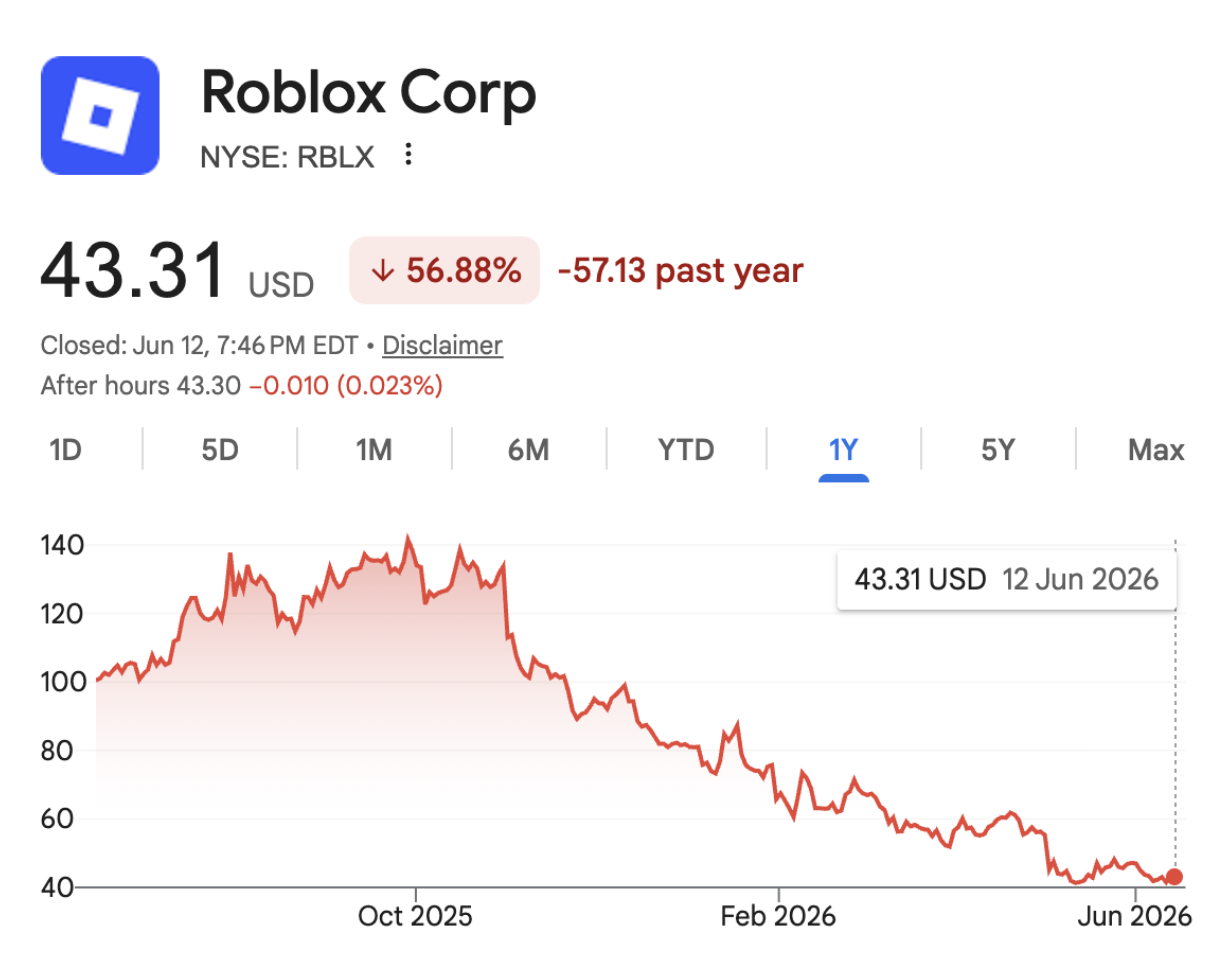
Safety spending at this scale is a growth strategy, and a counterintuitive one. The immediate effect of this investment is, well, very much in the investment and not the return phase.
Roblox stock
Roblox does not run major advertising campaigns. Matt Kaufman made this point directly: the company's growth has never been predicated on ad spend. It has been predicated on trust. Parents install the app because they believe it is safe. Kids stay because their friends are there. Developers build on the platform because Roblox handles moderation, policy enforcement, and safety infrastructure, so they do not have to.
That trust flywheel is Roblox's actual moat. And it is fragile. Every viral TikTok showing a problematic username, every podcast episode painting the platform as predator-friendly, every Instagram reel from someone who has never opened the app erodes the trust that drives installs. The safety investment is not separate from the business model. It is the business model.
And the cost is visible. In Q1 2026, daily active user growth dropped significantly, and Roblox cut its full-year revenue guidance, with CFO Naveen Chopra attributing the revision largely to safety-driven friction in user acquisition and engagement. A company does not voluntarily slow its own growth unless it believes the foundation it is building is worth more than what it is giving up.
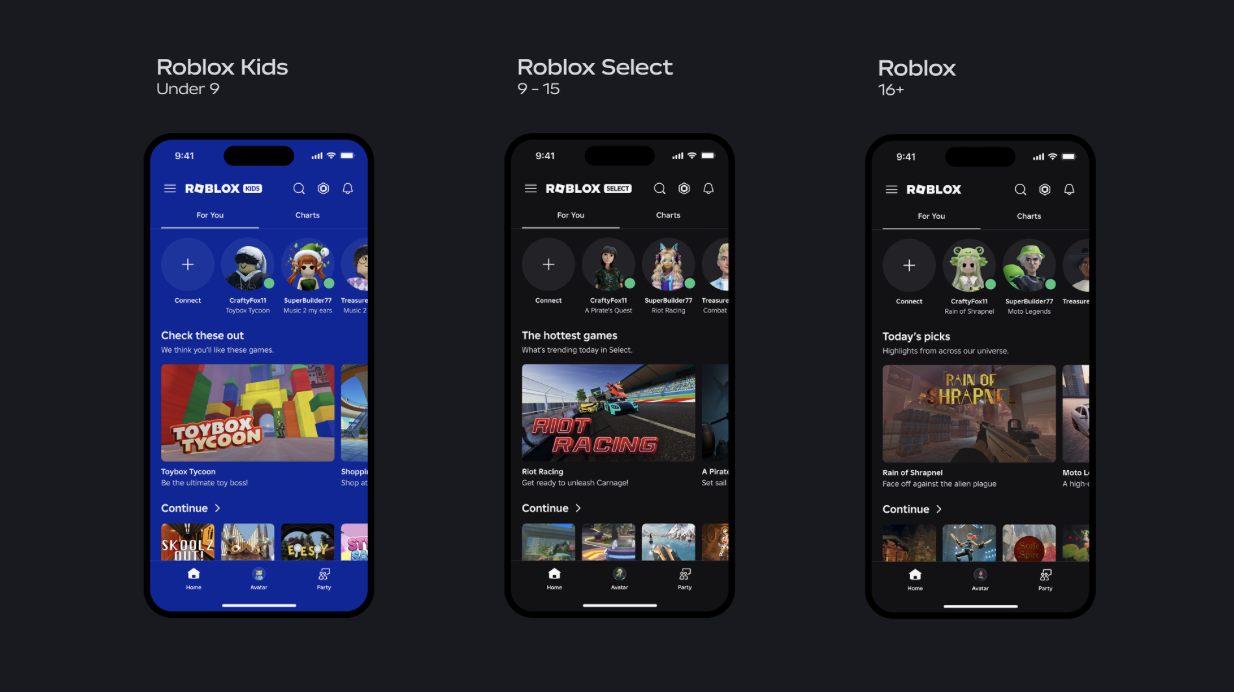
Roblox is introducing two new age-based accounts for younger users on Roblox: Roblox Kids for users ages 5 to 8 and Roblox Select for users ages 9 to 15.
This is why the June 2026 launch of Roblox Kids (ages 5-8) and Roblox Select (ages 9-15) matters strategically. They are a restructuring of the entire content delivery system around verified age cohorts. Kids' accounts get access only to a curated library of games where developers have provided government ID, content has gone through extended evaluation with older audiences first, and maturity ratings have been independently validated. Select accounts introduce graduated communication features, still filtered, still age-bracketed. The visual design is different for each tier, so a parent glancing at a screen can immediately tell which version their child is using.
The logic is elegant: make the default experience safe enough that parents do not need to become power users of a parental control dashboard.
The Credibility Gap Is Partially Self-Inflicted
None of this means Roblox has solved its perception problem. It has not.
The company spent years prioritizing critical harms, the most severe safety risks, while leaving a long tail of low-severity violations visible. A game called "Diddy's Playground" with nothing behind it. A username referencing Epstein. No actual harm, but corrosive to trust. As Kaufman acknowledged, "people would look at us and say, but I just found a user that was Diddy123725. Why? And I see it on Instagram. So how can you tell me that you're taking care of these really critical harms when somebody just created that username? And they were right."
Roblox spent years telling a sophisticated safety story to audiences who were judging it on surface-level artifacts. The investments were real but invisible. The failures were minor but viral. And that’s understandable, because there’s no tolerance for mistakes when talking about child safety.
The predator hunter controversy illustrates the gap perfectly. YouTube creators were catching predators by luring them onto Roblox, staging conversations, then publishing the footage. Roblox removed them from the platform with a cease and desist.
To the company, the logic was clear: these creators were importing bad actors, violating platform rules, and normalizing the exact behavior Roblox's systems are designed to prevent. To the viewing public, it looked like Roblox was punishing the only people trying to protect children. Eliza Jacobs described the reality bluntly: the hunters "were actually finding the bad actors off the platform and then bringing them onto the platform" for content purposes, "all in service of clicks."
Context does not travel well in 15-second clips. Roblox's challenge is making the systems legible to people who will never read a safety blog post or sit through an earnings call.
As a Parent, What Should I Actually Evaluate
Strip away the viral content and the platform politics and ask a structural question: compared to what?
The regulatory record is clarifying. The FTC sued TikTok in 2024 for knowingly allowing millions of children under 13 on a platform that officially prohibits them. YouTube paid $170 million in 2019 to settle COPPA violations. Epic Games paid $275 million in 2022, partly for collecting personal information from children on Fortnite without parental consent. They are the industry's largest players getting caught doing what Roblox chose not to do: pretend the kids were not there.
Compared to YouTube, where algorithmic recommendations can take a child from Peppa Pig to conspiracy content in three clicks. Compared to TikTok, where age verification is a checkbox on a platform, the FTC alleges built backdoors for children to bypass. Compared to Instagram, where DMs are encrypted, the company has repeatedly resisted transparency about minor user populations. Compared to Discord, where servers are unmoderated by default, and age verification does not exist in any meaningful sense.
For parents like myself, the practical calculus after June 2026 is straightforward. I’ll reinstall Roblox. Let my child complete Age Check on their primary device (a lesson Roblox learned the hard way when parents kept verifying on behalf of their kids). I’ll confirm the age is correct in parental controls. And my child will land in a curated, age-appropriate tier with filtered communication limited to peers, on a platform that monitors everything, encrypts nothing, and employs former law enforcement to investigate suspicious behavior.
No platform can guarantee zero risk. So the real question is, which platform is doing the most to reduce it? On that measure, Roblox is not close to the others. It is ahead of them, and they are spending aggressively to stay there. The way I see it, the company is building crosswalks, traffic lights, and guardrails while most competitors are still debating whether streets need speed limits.
Today, Roblox is back on the menu in the Katkoff household, not just for me, but also for my eldest daughter. Albeit I'm much more vigilant and take the age verification seriously.
Watch/listen to the full conversation with Matt Kaufman and Eliza Jacobs here