
The Screw Puzzle Gold Rush
Written by Ahmetcan Demirel, a true puzzler who plays, analyzes, builds and ships puzzle games.
Screw Puzzles have only been around for a couple of years, but they already sit near the top of the Hybridcasual Puzzle pile. The appeal is obvious: Fast readability, satisfying interaction, and a clean decision loop that scales without getting messy.
They have also shown traction with IAP revenue. Screw Puzzles are now second only to Sort Puzzles in IAP revenue, even outperforming Block Puzzles, which is an impressive climb for a mechanic that only really hit the market in 2024.
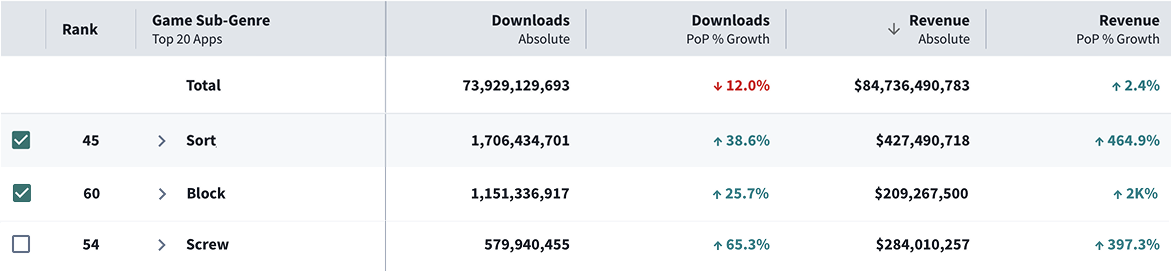
While Screw Puzzles’ increase in IAP performance is impressive, the total rise of the Hybridcasual Puzzle market is also worthy of mention.
That climb forced rapid iteration. In roughly a year, Screw Puzzles evolved hard on both design and monetization, from “unscrew and clear” prototypes to tighter gating, sharper fail moments, and more deliberate paywalls.
So, if you want a compact case study on how Hybridcasual Puzzle mechanics mature fast, Screw Puzzles are it.
Screw Jam’s Blueprint
It is fair to say that Screw Puzzles started with Screw Jam by Rollic. Released at the end of 2023, it picked up speed fast in 2024 and turned into one of the year’s breakout Hybridcasual Puzzles.
2024 has been a great year for Screw Jam as it made almost $25M alone in IAP revenue.
What made it work was not complexity. It was a small set of design principles that the rest of the genre basically copied.
The first staple is layering through occlusion. The game hides items behind other items, and it does it cleanly. Screws are stacked in layers separated by translucent glass, so you always see “some” of what is coming, but never the full picture. The level goal is simple. You need to clear the board. The constraint is also simple: You can only access what is on top, so you must clear the upper layers to reach the deeper ones.
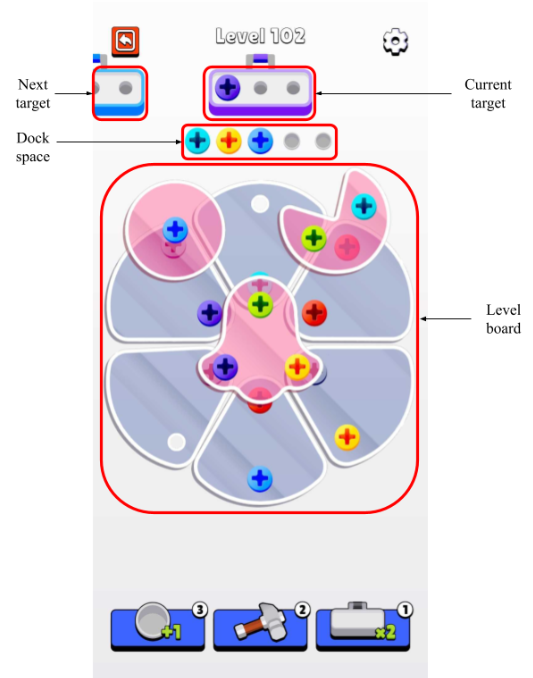
Screw Jam with the blueprint it laid out for Screw Puzzles.
This is where the game gets deeper, literally. You are not just clearing the first screw you see. You are choosing which screws to free up, because every selection changes what becomes reachable next as you go deeper. That creates a naturally static level structure, but one with multiple choke points. You can feel the junctures where a bad sequence will corner you, and you can feel when you have successfully opened the level up.
That structure gets even more depth with a clever addition: The colored boxes at the top of the screen. Each time, the game effectively tells you “Match three screws of this color”. If you pull screws without thinking about what you are exposing, you walk yourself into a fail state. Not because the game is unfair, but because it is consistent. The boxes give you a target. The board gives you a route. The ambiguity in that route is the whole puzzle.
Then the game adds a pressure valve that makes mistakes survivable, but not free. The dock slots under the boxes give players space to stash “spare” screws that do not fit the current box. This does two jobs at once:
It stops the game from punishing you on your first mistake
It keeps the leash short, so careless play still collapses quickly
Small touches push the perceived depth even further. Showing the next box partially turns the sequence into planning instead of reaction. The translucent glass gives partial information about deeper layers, enough to form intent, not enough to play perfectly. These are cheap tricks, but they work. They make the player feel smart when they are right, and responsible when they are wrong.
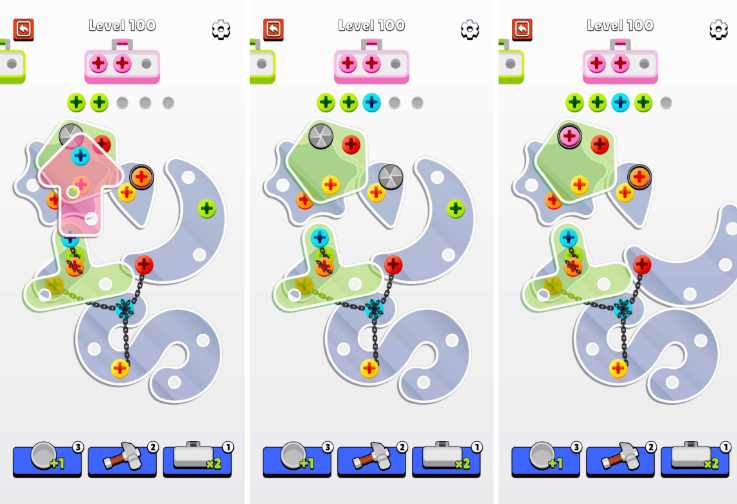
Classic Screw Jam chokepoint: You need a pink screw to finish the current target, but none are visible. You pull a screw to open the next layer, then another, and only then discover where the pink screw was buried all along…
But, most importantly, Screw Jam’s design does not just allow monetization. It creates it. Every meaningful limitation is also a purchase hook:
Limited dock space creates the “extra slot” power
Colored boxes turn into “extra box” helpers
Layering turns into “break a glass” intervention
None of this feels bolted on because the level is already built out of constraints. The monetization just sells relief from those constraints, right when the player can point at the exact problem they caused.
And this tight coupling between level structure and monetization is the part that mattered most. It set the template for what Screw Puzzles became next…
Screwdom and the Discovery Trap
After Screw Jam introduced Screw Puzzles to the market, the original blueprint got copied fast, then got iterated even faster. The second wave of Screw Puzzles did not just reskin the loop. It looked for smarter ways to create depth, higher stakes, and cleaner monetization pressure.
The current winner of that second wave is definitely Screwdom.
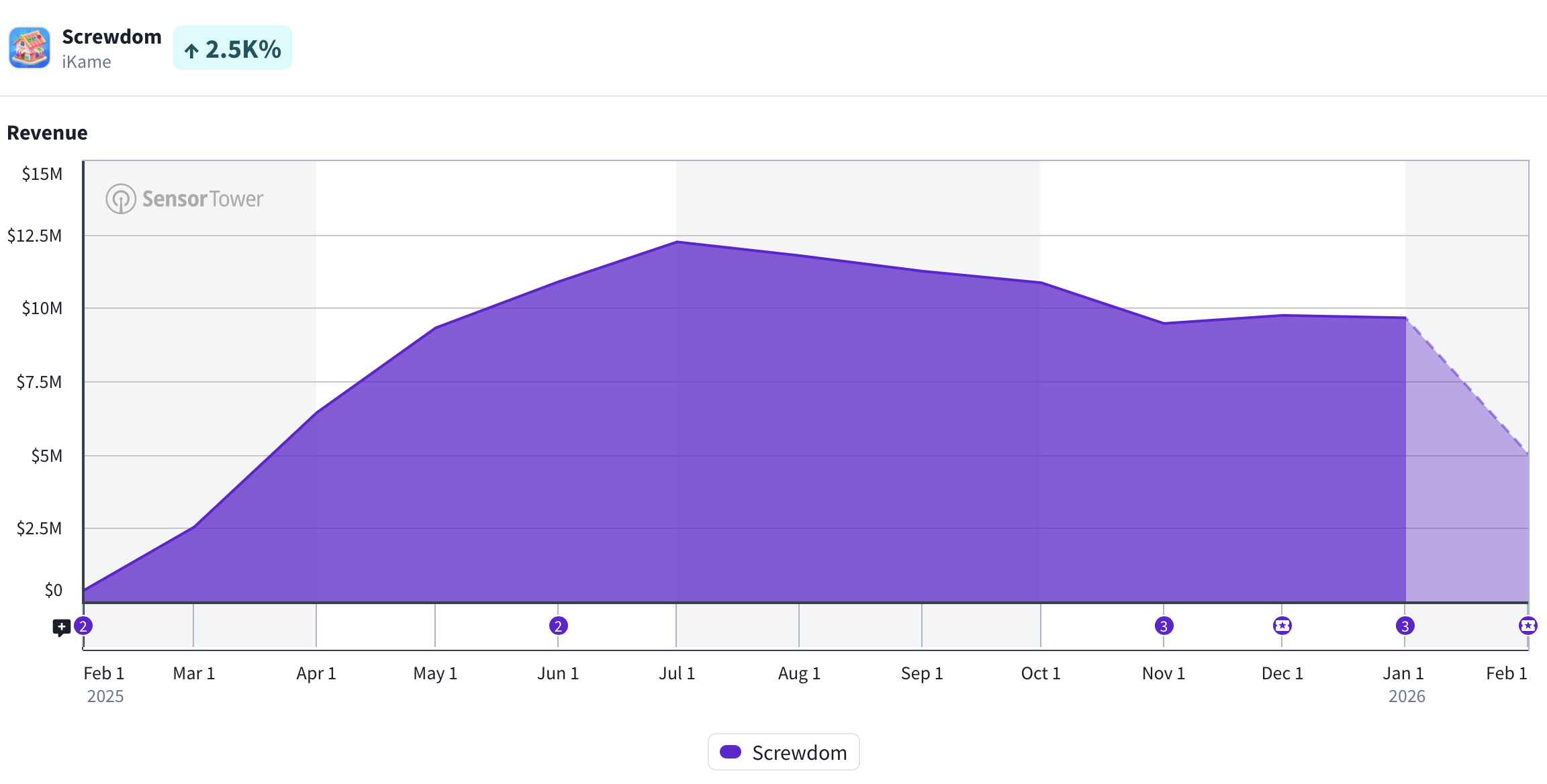
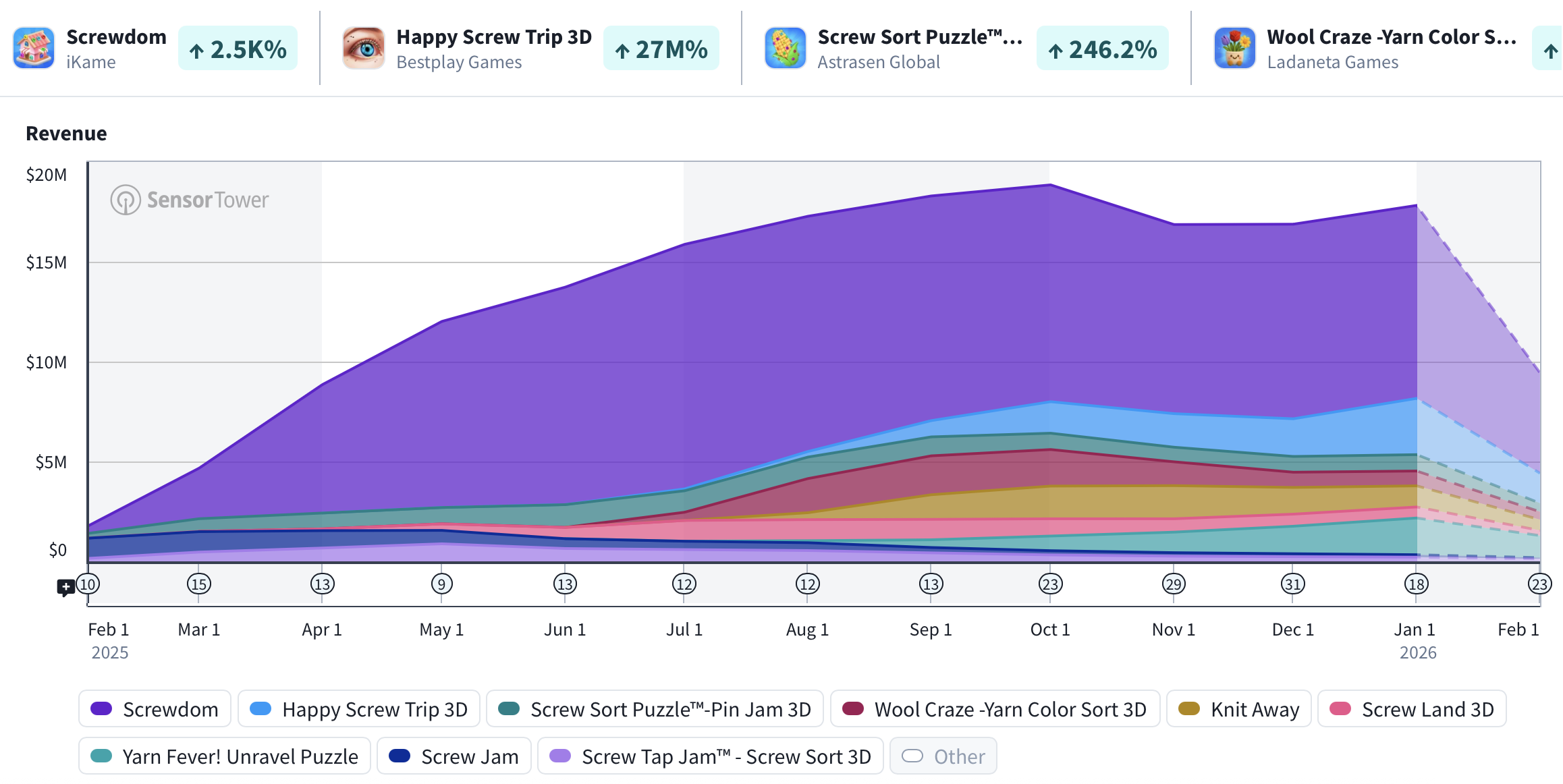
Screwdom pulled in over $75M in 2025 from IAP alone, while still running interstitials after every level and stacking rewarded ads.
Screwdom had a terrific 2025. It started the year as a Hybridcasual Puzzle, then basically completed its evolution into a more “Casual” puzzle as we discussed before. Cleaner look, more mass market feel, and a design that is still simple on paper but far more effective at shaping player behavior.
Design-wise, Screwdom keeps the Screw Jam playbook, but adds a few key twists.
The biggest one is the move to 3D level design. What used to be “layered screws stacked behind translucent glass” becomes “screws holding a 3D object together”. Every move unravels the object a bit more. This does two important things at once:
It makes the puzzle feel tactile, like you are actually dismantling something
It turns level progression into a visible transformation, not just a cleanup task
But the 3D shift is not just a feel upgrade. It is the foundation for a core principle that Screwdom leans on hard: Discovery through play.
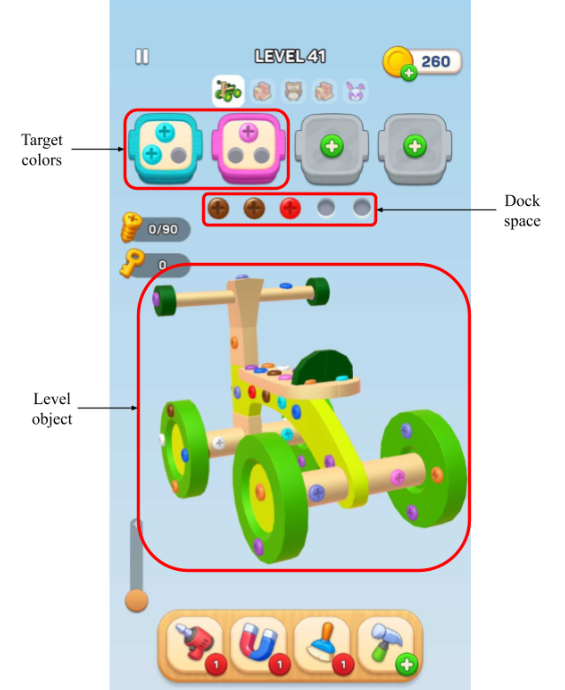
Screwdom’s discovery-first structure that dominated the Screw market.
In Screw Jam, you can more or less read the whole level up front. The translucent glass blurs detail, but the overall structure is visible. There is limited mystery. You plan, you execute.
In Screwdom, more than 80% of the level is hidden. The player cannot fully plan because the game refuses to reveal the board. To learn what is coming, you have to keep playing. That sounds like a small change, but it rewires the emotional loop. Players get invested because they just unlocked new information, and now they want to see the next reveal.
On top of that discovery-first structure, Screwdom adds a simple mechanic that increases perceived depth without adding complexity. Players can peek into deeper layers with an X-ray-like feature.
Because players rotate the 3D object to find screws of different colors, Screwdom also lets them see one layer deeper while holding and dragging. It is basically an X-ray glimpse. The level is still mostly hidden, but the game gives you just enough extra information to play strategically. It is a clever balancing act between extreme fog of war and a tiny tool to feel in control.
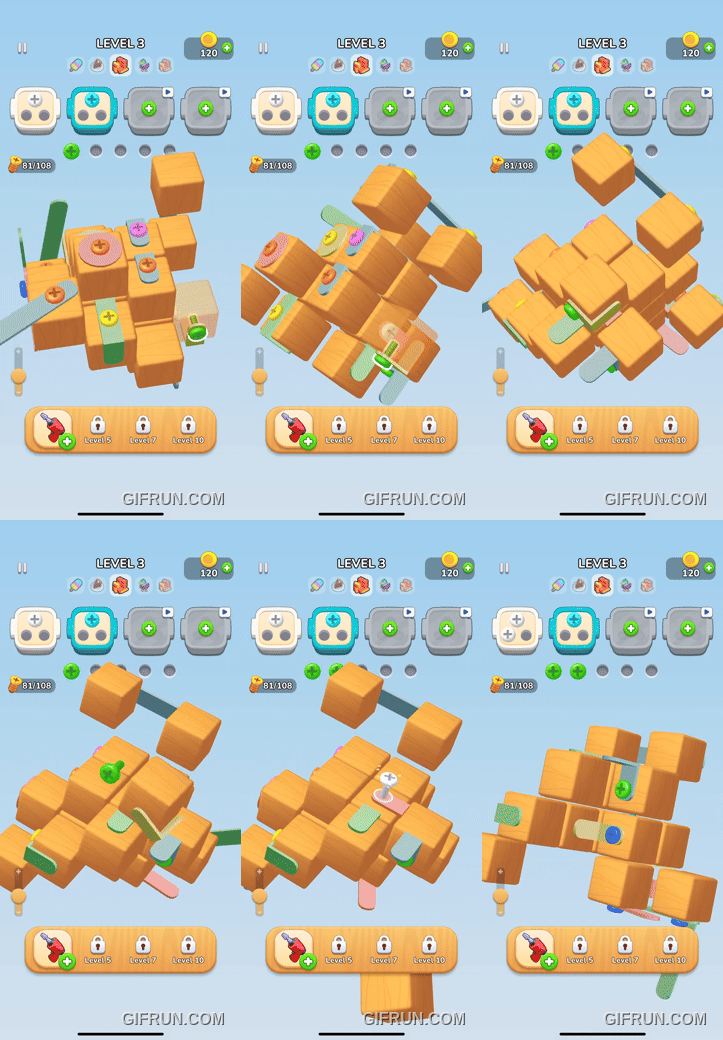
To find a target-color screw, players must dig into deeper layers without wasting too many dock slots.
Then Screwdom expands the move space. Where Screw Jam pushes you toward matching a single target color at a time, Screwdom allows matching two different colors at any moment. That sounds minor, but it is not. It widens the decision tree and increases capacity at the top of the loop. Screw Jam’s “current color plus dock” constraint is tight. Screwdom’s “two active colors plus dock” gives you more options, and more options means more ways to postpone the real choke point.
And that is exactly what Screwdom wants. All this discovery within play culminates in high-stakes failure, and the timing is the trick.
Most Screwdom levels feel relaxing for the first 3 to 4 minutes. The game gives you roughly 20% of the level upfront, so early progress comes easily. You clear a few colors, you feel smart, you keep going. Then the level starts showing its static side. Even if the top boxes feel dynamic because they are not all visible at once, the sequence is usually pretty fixed. At some point, you must pull specific screws in a specific order if you want to stay within the dock limit.
And, crucially, this moment hits after the player has already invested considerable time.
That is when the EGO (End Game Offer) becomes useful more than ever. It is no longer a simple “pay to pass”. It is “pay to not waste the five minutes you already spent”. Screwdom is not selling victory. It is selling time, progress, and a level win in one button.
This is a brilliant case of level design boosting monetization. Screwdom shapes the experience inside the level: It lets players wander, discover, and feel momentum until the space collapses. And when there is nowhere left to go, the EGO shows up as a convenient tool to save both the level and the time already sunk into it.
Yarn Skins, Same Playbook
While Screwdom keeps dominating the Screw market with a consistent monthly IAP run-rate of $7.5M+ (and likely similar ad revenue on top), a new take has started popping up lately: Removing layers of yarn. This “new generation” takes the 3D object idea a bit too literally. Each move is not just removing a screw, it is visibly picking the level object apart.
Under the hood, though, this is mostly a cosmetic reskin of the Screwdom playbook:
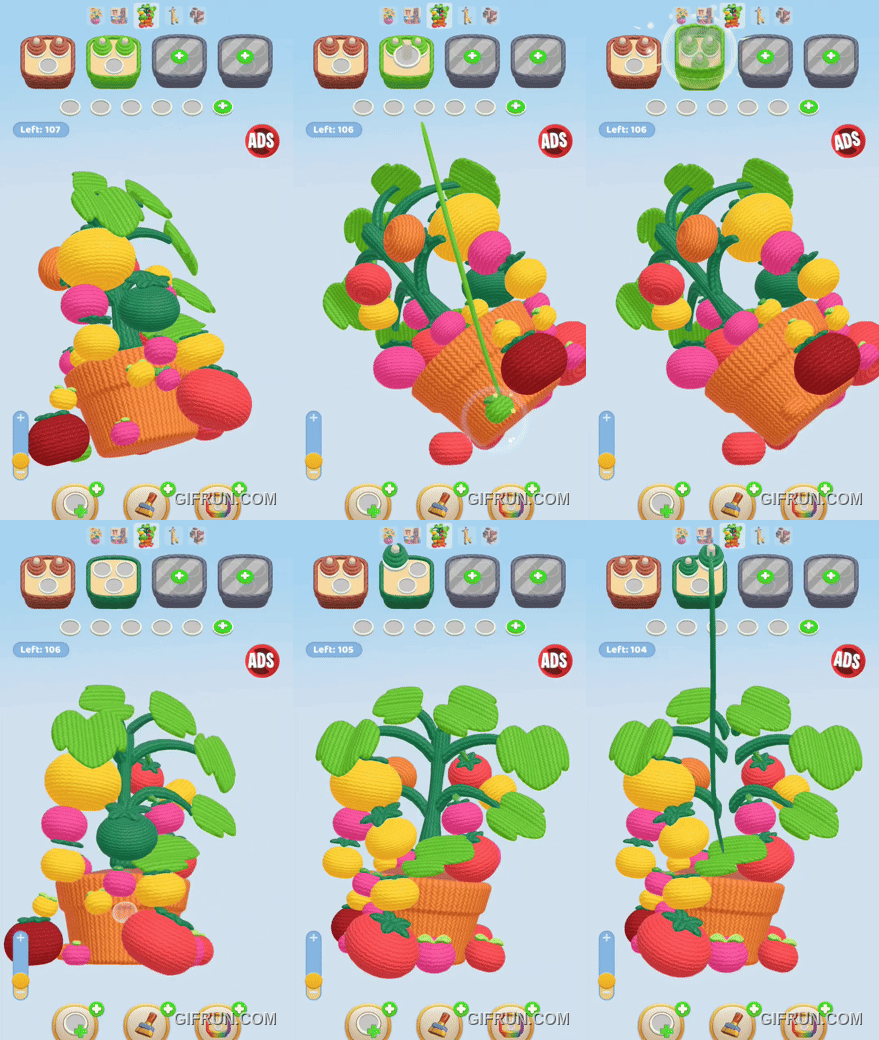
A standard Wool Craze level, a top yarn reskin of Screwdom.
You still see only ~20% of the level upfront
You still get two target colors and limited dock slots at the top
You still win by discovery through play, not by fully reading the board
It honestly feels better than Screwdom moment to moment, because yarn as a material sells the “unraveling” fantasy more cleanly. The visual is more integrated, so the interaction feels more immersive.
But if the core gameplay and monetization do not move forward, the ceiling stays the same. And that is exactly what we are seeing. Compared to Screwdom, and even compared to some of the stronger Screwdom copies, these yarn-skinned variants have been underwhelming.
A standard Wool Craze level, a top yarn reskin of Screwdom.
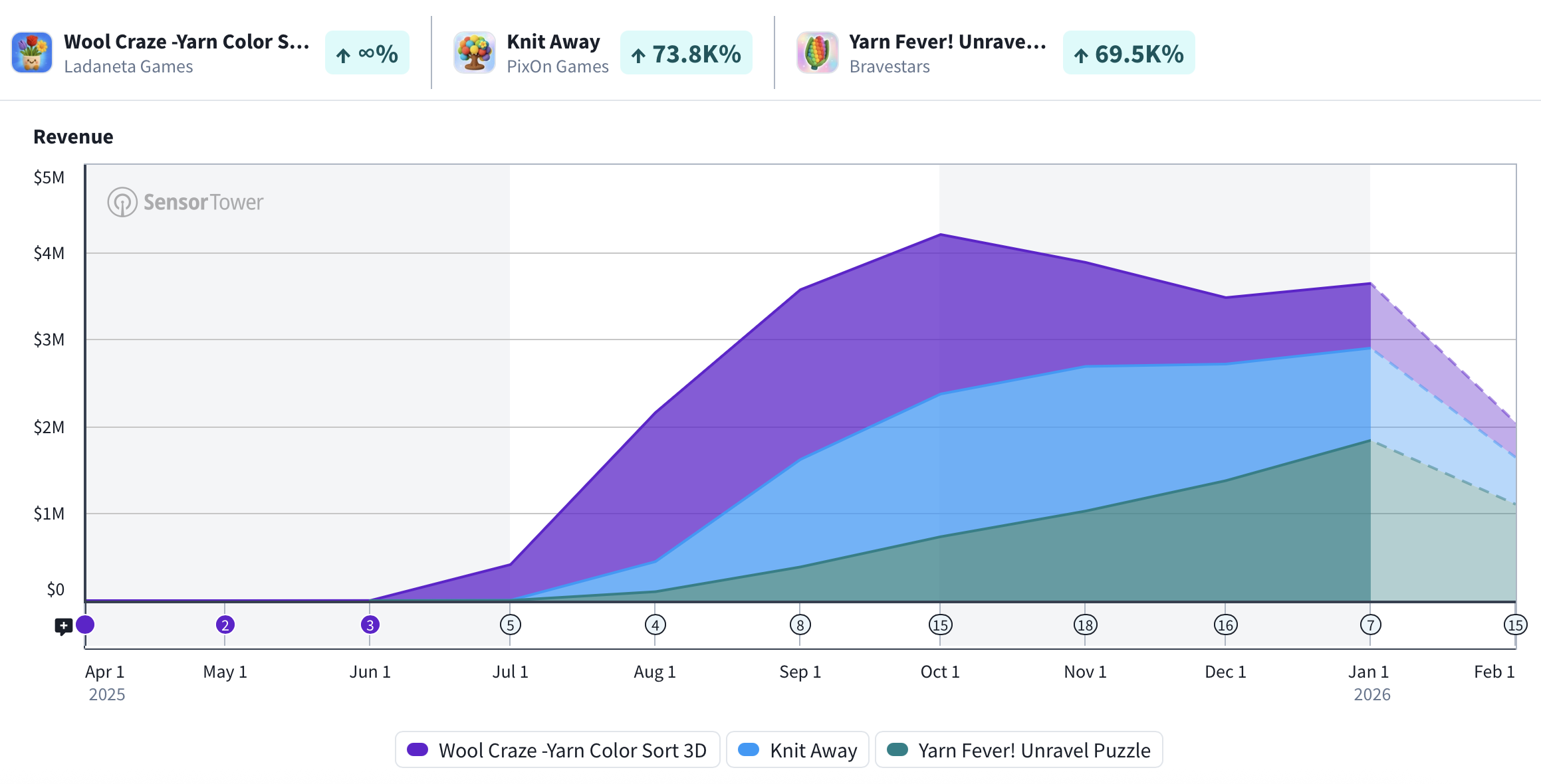
Wool Craze, Knit Away, and Yarn Fever climbed the charts in late 2025, challenging Screwdom clones like Happy Screw, Screw Sort, and Screw Land.
Still, the timing matters. The fact that these yarn versions showed up in the second half of 2025 and are still being discovered is a strong signal that the Screw market is not exhausted. There is still an appetite. There is still room to climb.
My bet for 2026 is not “more skins.” It is gameplay that injects dynamism into a naturally static structure. Block Jam 3D is a clean example that we discussed before. It takes a fundamentally static core, then adds systems that shift the board state and force new decisions mid-level. That formula has been copied for a reason.
Screw Puzzles will keep their static backbone and the discovery tension that comes with it. But the team that adds real dynamism on top of that structure, without breaking readability, will unlock the next phase of growth.
Of course, only time will tell if anyone gets close to what Screwdom has pulled off so far…
