What Mihai Pohontu, CEO of Amber, taught me about co-development after the crash
Amber's engineers can write code up to 80% faster with AI, according to the company's own internal reports. Most of its Western partners will not allow any of it in the work they buy. They pay extra for slower, more expensive output, and they call it caution.
That gap, between what co-development can now do and what buyers will let it do, is the most interesting tension in external development today. I sat down with Mihai Pohontu, CEO of Amber, to understand what happens to this business when the billable hour starts to die.
Amber was founded in Bucharest in 2013. It is a network of studios that now employs more than 900 people across eight locations, according to its Q3 2026 overview, and it counts Netflix, Amazon, King and Roblox among its biggest partners. Mihai joined as CEO in 2017, later moved up to chairman, and returned as CEO in the middle of the crash that followed the COVID boom. He watched that crash from the one seat that sees it first.

Mihai Pohontu, CEO of Amber. Photo: Amber.
Listen to the full conversation on Deconstructor of Fun.
If this is the kind of operator writing you want more of, get the DoF newsletter.
The outsourcer is the canary in the coal mine
A publisher announces a 20% layoff and the industry hears about it the day of. Meanwhile, co-developers knew it for months in advance. The project was likely pulled in-house months earlier. The layoff was just the last nail.
"Usually by the time they announce their internal layoffs, we've already felt the impact months ago." Mihai Pohontu
Under financial pressure, every studio protects the team it knows and loves and cuts everything else. And yet that action is counterintuitive, because you're pulling work back from a cheaper external team into a more expensive internal one. The result is increased cost per developer at the exact moment the CFO wants it lower. I have watched this inside studios more than once. Stopping co-development to cut costs is the most rational irrational decision studios make, along with building their own tech and tooling.
Read more: The hidden cost of studio engineering
Mihai also believes public trackers like Amir Satvat's capture maybe 10% of real cuts. White-label vendors and small indies are invisible in that data. Amber, for example, never announced its own. Whatever the true number is, it's worse than the one we quote.
Publishers are paying extra for slower output
Amber's internal reports show up to 80% efficiency gains in code writing with AI. And yet most of its Western partners won't allow any of it in their deliverables. They literally pay extra for a co-developer to be slower and more expensive.
"Studios basically pay extra for handcrafted work." Mihai Pohontu
The reason is legal. Copyright cases are still working through the courts, and Western legal departments fear that any AI-generated asset or line of code becomes a future liability. Mihai actually defended the caution. In a market this litigious, the exposure is unfortunately real.
I'm less charitable. I keep hearing that some of the biggest Asian mobile publishers already run most of their asset creation through AI. Western publishers are so afraid of being sued that they are handing Asian competitors yet another structural cost advantage.
And I understand why Mihai is sympathetic to the ban. It is currently protecting the outsourcing business. A vendor billing by headcount doesn't benefit from working 80% faster. The day legal says yes, procurement will ask for the discount. That's when the external-development model gets tested.
Read more: Outsourcing is dead. Long live co-development
While agents compound, experts correct
In the age of AI, why hire a co-developer? Mihai's answer is specialization. A stack of proprietary and off-the-shelf tools, orchestrated and battle-tested across dozens of projects, is hard for one studio to replicate.
"Even if you have armies of agents running around, they may simply compound the error instead of fixing it." Mihai Pohontu
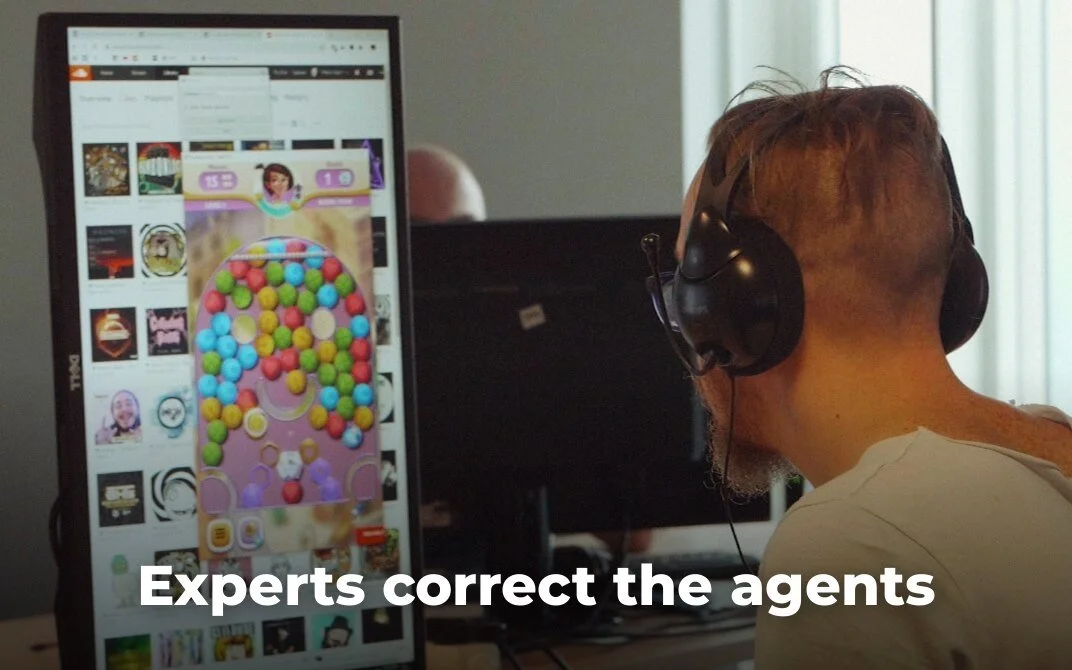
An Amber developer testing a puzzle build. Tools speed up the work. Judgment decides if it ships. Photo: Amber.
This matches what I see inside the studios I work with. Senior engineers with good tooling finally deliver the mythical 10x. Juniors with the same tools don't, because they can't tell when the model is wrong. Mihai was even more blunt, saying junior engineering as we defined it has no place in this world. His optimistic take is that juniors become solo creators and founders instead. I buy that they can build the game. I'm less sure anyone will find it.
I am less absolute. I have also seen motivated juniors, the ones not held back by old habits, invigorate a senior team, and I have seen some of them reach senior-level judgment faster than before. I still would not staff a project with juniors who cannot tell good output from bad.
Read more: How game studios should allocate their AI budgets
A service company is not a game company
I asked the obvious question. A company of this size, AI that makes its people faster, every skill needed to ship a hit. Why not make your own games? Mihai's answer was the most honest thing he said all hour.
"If you build a service organization, probably mastery in creative development is not really the key attribute that you're going to build." Mihai Pohontu
Amber bootstrapped through services because the founders had no idea how to raise money. They had a plan to reinvest profits into original games. And they did make several. But these games served another purpose. Its own games were where Amber first did serious Unreal work and where it first experimented with AI.
The clearest example is Courtroom Chaos, an LLM-native party game where players argue cases in front of an AI-driven Snoop Dogg acting as judge. Amber pitched ten concepts to Amazon, Amazon funded one, Amber built it. It's real design innovation. It's also Amazon's IP, published by Amazon Games. That is co-development working exactly as intended.
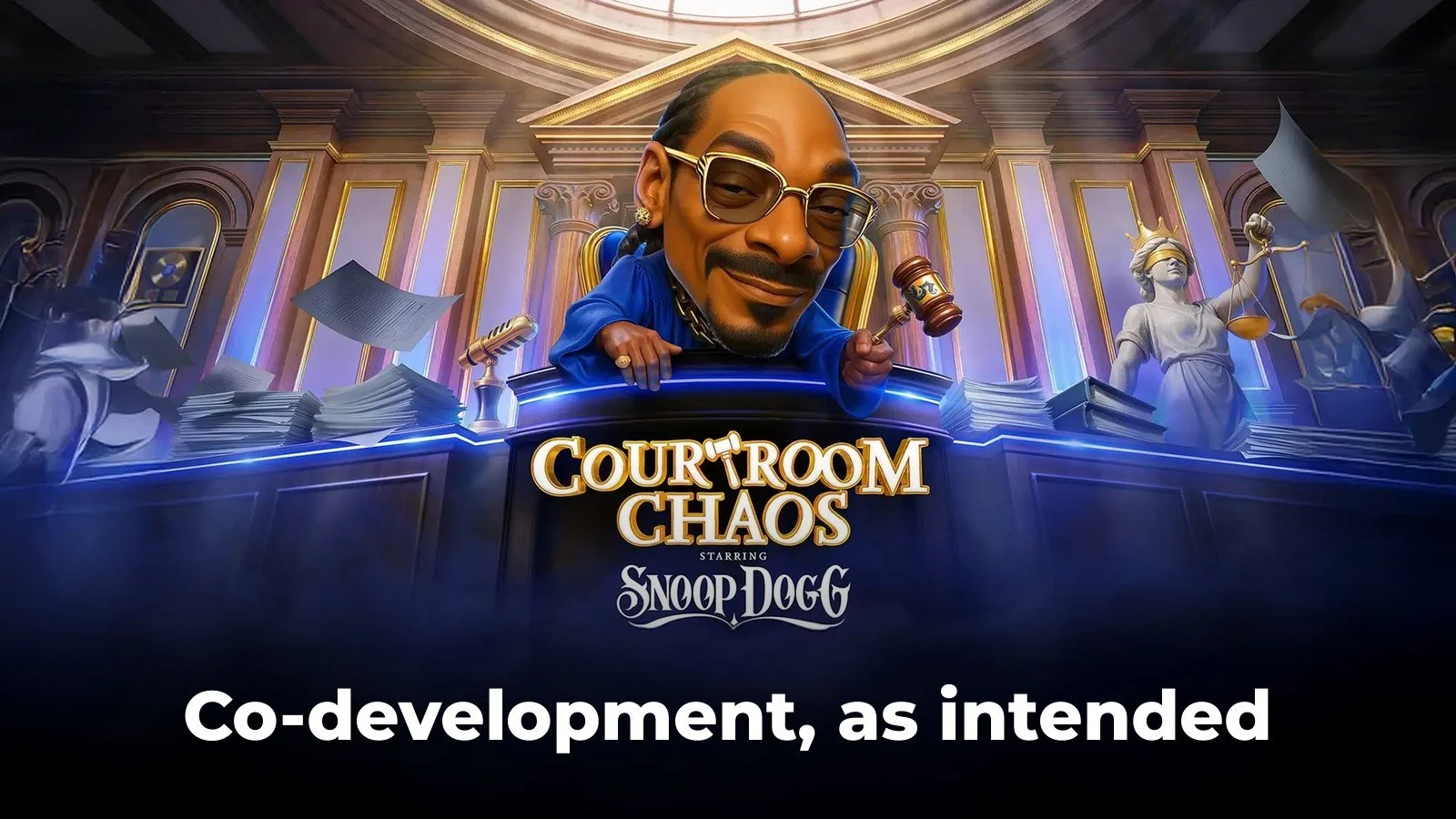
Courtroom Chaos starring Snoop Dogg. Built by Amber, owned and published by Amazon Games. Image: Amber / Amazon Games.
Would never shipping an original hit be a failure for Amber? I don't think so. It's the business they're actually in. The risk is only in telling a different story to investors and recruits.
Infinite games, finite distribution
I pushed Mihai on whether AI de-risks game making. Build a hundred concepts for the price of one and surely one finds product-market fit. He disagreed, and he was right.
"The red ocean of game distribution is definitely the black ocean, and the carcasses are already in there." Mihai Pohontu
Content gets cheaper. Attention doesn't. If you can make a thousand games, so can everyone else, and nobody can market a thousand games. His prescription was the classic one: make something memorable and new.
I called it the best-pizza argument. True, and simplified. Nobody can prove GTA 6 is the best game ever made. Everybody knows it's the most marketed. The top Turkish studios win with aggressive marketing, relentless iteration and unnerving business focus. Mihai conceded that craft is no guarantee, and called the Turkish approach an algorithmic form of innovation. I like to call it peak iterative innovation.
Co-developers are becoming co-investors
Publishers are starting to ask co-developers to become co-investors. Mihai's example: a $1 million service contract drops to $500,000, and Amber takes a 20% revenue share. Amber has signed several such deals and inbound requests are growing.
I love the alignment. Lose money when the game fails and you show up differently. Now run the base case. Giving up $500,000 for 20% of revenue means the game must make $2.5 million before Amber breaks even, ignoring time value. Most games never get there. Take enough of these deals and a services company becomes a venture portfolio with game-industry hit rates, funded from thin service margins.
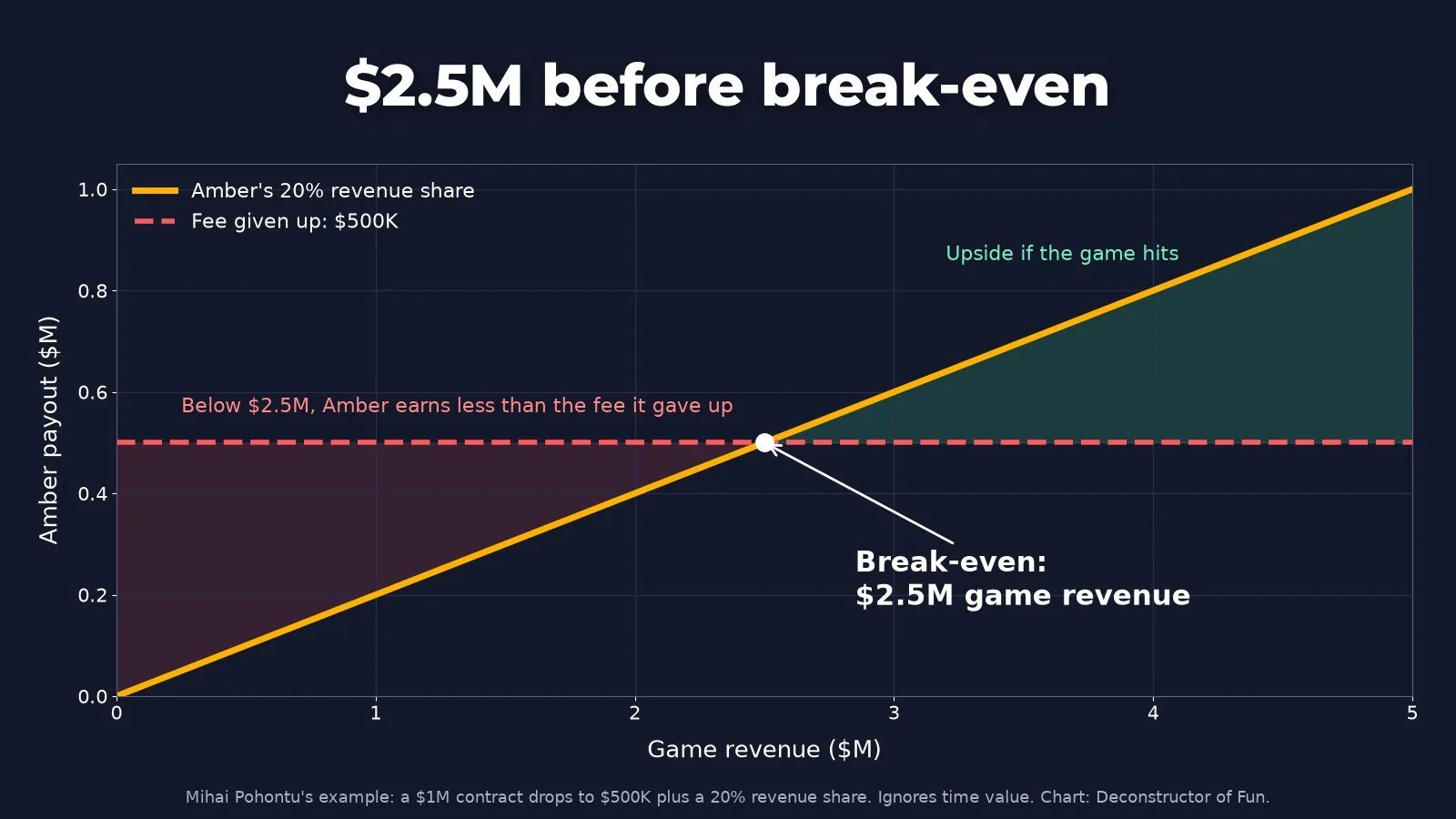
Half the fee for 20% of revenue: the game has to make $2.5M before Amber is even. Chart: Deconstructor of Fun.
If five people can build a city, the business stops selling hours and starts selling judgment. That's a great future for the best shops and a brutal one for anyone whose model is headcount times day rate.
For more of this kind of writing, subscribe to the DoF newsletter.
Check the weather
Amber was built on an idea borrowed from Japanese corporations.
"We thought that was a very romantic idea to work for a single company your entire career." Mihai Pohontu
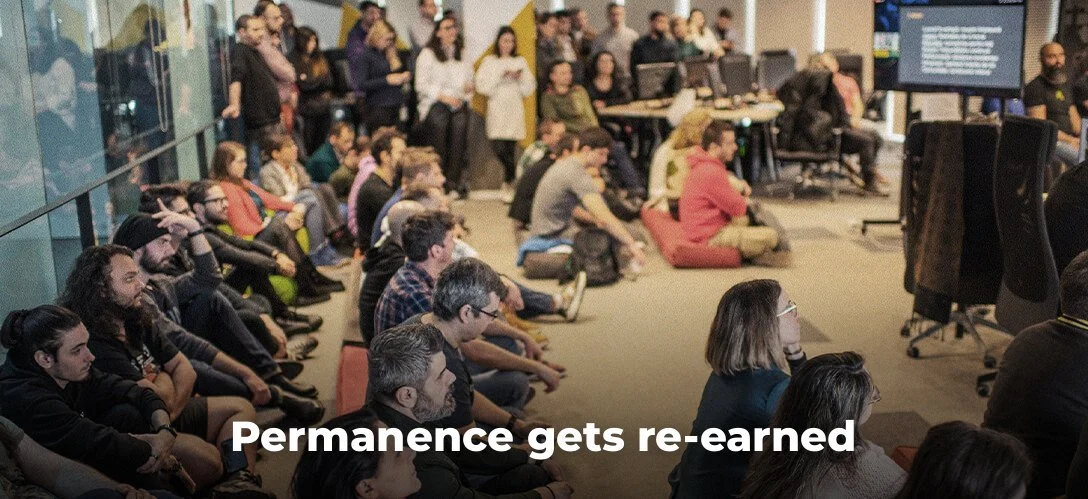
Amber’s team in Bucharest, where the company started in 2013. Photo: Amber.
For nine years it worked. Then 2023 showed the whole industry what "recession proof" was worth. When I lived in San Francisco, two sunny days in a row meant shorts on day three without checking the forecast. Games did the same with COVID. We extrapolated an aberration and hired for it.
Mihai thinks AI now sits at the peak of its hype cycle, with a crash ahead before it settles into something transformative. Same pattern, new weather. Permanence is a fine aspiration. It just has to be re-earned every cycle, by people willing to change what they sell.
Check the weather. Especially on the third sunny day.
Related reading
Outsourcing Is Dead. Long Live Co-Development