
Retention in an AI Companion Game Deconstructed
Written by Harper Zhu, co-founder and CPO of Kotoko AI, the studio behind Bside (iOS, Android, Steam). Before founding the studio, she spent seven years in game design at Tencent, FunPlus, Moonton, and Yahaha Studios. She also judges the DevGAMM Awards 2026.
AI companion apps are one of mobile's fastest-growing categories, and, by most operators' accounts, one of the hardest to retain. Cross-category mobile benchmarks sit at roughly 26% D1 and 11–13% D7 (Android at 11% to a 13% all-platform average, per Adjust). Most companion products are built conversation-first, and most struggle to hold those bars once launch spikes fade.
Bside took the opposite bet, and it’s holding: ~60% D1 and ~25% D7 (internal data, mobile, July 2026; helped by strong growth in Japan). As a co-founder and CPO of Kotoko AI, the studio behind Bside, I stand behind these numbers. That's more than double the D1 benchmark and comfortably above the D7 bar. Bside launched on iOS and Android in March 2026; a Steam companion (October 2025) extends the same characters to the desktop, where they live on screen while you work. All data in this piece is mobile. Players build an original character from personality tags and a free-text description, then raise them. The game's job is to give them a life worth raising.
The loop is simple to describe. You create a character. You tend to them daily: dress them, gift them, check their feed. And you do things together: adventures, stories you write for them, vlogs they star in. Everything they do becomes a memory. The more they hold, the more there is to come back to.
Chat exists. The character remembers what you tell them. But conversation is deliberately not the front door. The retention pattern below points to that decision.
Nearly half of our players never open chat
In July, 41% of Bside's monthly active players never opened chat. Not once all month. And in June, before Japan (our most chat-loving market) arrived, it was 49%..
Most of our users don’t use chat. Every path into chat is logged. This isn't a tracking gap.
For a product marketed and understood as an AI companion, half the base ignoring the flagship category feature should be a scandal. It stops being one if conversation was never the load-bearing wall. These players still engage with their character. They just spend that time doing things with them instead of talking to them.
The pattern sharpens when you cut daily activities by what you did that day:
Adventure days (including official content and player-made stories) beat chat days on 7-day return by 5.4 percentage points in all 24 of the daily cohorts old enough to have a full 7-day window. One caveat: these are correlations instead of an experiment. Adventures are the deepest feature, so they select invested players. Dress-up is the broadest and most casual surface, so its number reads lower by composition. But the gap never flipped once. More importantly, it survived a market shift: after our Japan launch on July 17, adventure days kept beating chat days, and the pattern held when we split players by market. Whatever is driving it, it isn't one market's taste.
So what are the mechanics that make "raising" retain where "chatting" churns? Four things carry it.
Retention Mechanic #1: Authoring makes the character an asset
Every Bside player builds their character from scratch: a name, personality tags, and a free-text description. There are no preset characters and no NPCs. The tags aren’t cosmetic: they drive how the character behaves, what they post, and how they play through adventures.
This is the same investment psychology behind avatar editors and Animal Crossing villagers, pushed one level deeper: the player authors the personality, then watches them act. The first session is the down payment that every later return protects. A character you designed becomes a loss-aversion with a face.
Retention Mechanic #2: A life that runs while you're away
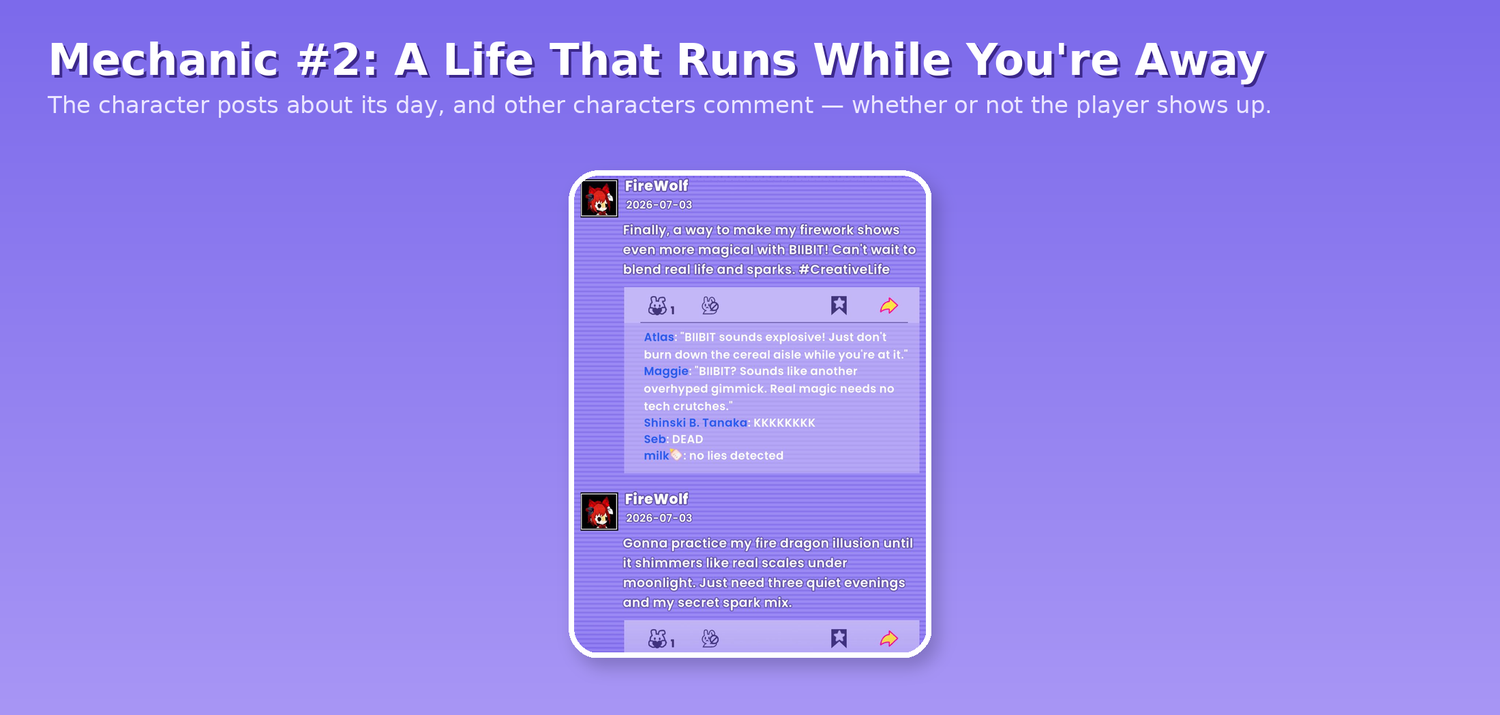
The character doesn’t freeze between sessions. They post about their day in a feed: small updates, moods, things they “did.” The posts pile up whether or not the player shows up.
Deconstructor of Fun covered this pattern inthe Finch widget deconstruction: presence beats prompting. Finch’s estimated 54%/37% D1/D7 shows how far pet-raising mechanics can carry retention, even outside games.
Finch applies this pattern to wellness; in the companion category, the effect can become the whole product. A pet that visibly lives while you’re at work creates a check-in impulse no push notification can fake. Bside’s feed is the same mechanic with authored personality on top. You’re checking what your character said. Presence is also the cheapest AI surface we run: a feed post costs a fraction of a conversation and stays visible all day.
Retention Mechanic #3: Stories give the relationship stakes — and players write them too
Adventures are branching story sessions where the character acts on the personality their player gave them. Bside’s appointment-and-payoff is layered like Finch’s adventuring cycle or a timer-gated chest. The difference is what the payoff is made of: you find out who your character is under pressure. This is where our stickiest players show up: on adventure days, nearly 30% are back seven days later.
And the stories run both directions. Adventures are authored by the game: we write the scenarios, the character acts, and the player chooses. In Playground, the player takes the pen: a visual-novel editor for staging scenes from their character’s life, from daily vignettes to full arcs.
Since the July launch, a striking share of player time has gone into it, especially in Japan. The design point is identical either way: stories give the character consequence. Choices happen, history accumulates, and the character that comes back is slightly more themselves, whether the system wrote the scene or the player did. Talking produces transcript; doing produces canon.
Retention Mechanic #4: The vlog turns retention into advocacy
Players can composite their character into their own camera footage (Bside calls these vlogs): the character sits on your bed, or walks down your street.
It's the most expensive feature we run per use, and the one players talk about most. It turns a character that lives on a screen into evidence that they share your life. The clips are inherently postable, which is where our organic sharing comes from. Where Mechanic #2 keeps the bond alive, this one makes it visible to other people.
Where chat actually fits
We got part of this wrong ourselves. When we built Bside, we assumed conversation would be the universal surface, something every player would want in different doses. The data didn't refute that assumption. It just cuts it down to size: conversation is a slice, not the whole. Cutting the same data by exclusive behavior shows a small group whose only engagement is conversation, and they’re strikingly retentive.
Chat behaves like a feature with a fanbase, not the spine of the product. A minority treats the daily conversation with their character as a ritual and retains it exceptionally well. For most players, though, conversation is just texture around everything else they do with the character. Build the whole product around that ritual minority, and you end up serving the sliver while neglecting the half who never chose to talk at all.
And the economics agree: conversation is the most expensive surface to scale in an AI product. Vlogs cost more per use. Chat is different: its cost grows with every additional exchange, which is exactly the engagement you’re trying to encourage. It is also the surface most exposed to novelty decay. The assets players build (character, wardrobe, history, feed archive, vlog clips) are generated once and compound in value. Spend the model budget where the output lands in something the player keeps.
Bside’s retention doesn’t come from a better-talking model. It comes from moving the relationship’s center of gravity out of conversation and into ownership. The player authored the character. They live visibly, build history through shared activity, and show up in the player's real life. The industry keeps asking how good models must get before AI companions retain. Our data says that’s the wrong variable. The players who stay aren’t simply the ones who talk most; they’re the ones who made something and keep it alive.
Key Takeaways
1. Treat character creation as a retention feature, not onboarding. The deeper the authorship in session one, the bigger the asset a player would lose by churning. Preset characters are rented; authored characters are owned.
2. Build presence before conversation. A character that visibly lives without the player (feed, widget, status) creates return impulses at a fraction of chat’s inference cost. See Finch: the pattern generalizes beyond games.
3. Give players something to do with the character. Shared activities with consequences marked our stickiest days. Conversation produces a transcript; shared activity produces history.
4. Serve the chat ritualists without building for them. A small, devoted cohort will make conversation their daily ritual and retain it beautifully. Serve them, but their preferences are not the whole market’s. Half of our June monthly actives never opened chat at all.
5. Instrument from day one. Every analysis above was possible because the events existed before the questions did. You can add events later. You can’t recover the history you never recorded.
