Loyalty Platforms 101: The Complete Guide to Gaming's Fastest-Growing UA Channel
In a recent podcast conversation, I sat down with Ido Raz, founder of VYBS, to decode loyalty platforms—a channel that's evolved from the sidelines to commanding 25-50% of major studios' UA budgets.
The Incentivized Traffic Myth
If you've been in the industry for 15 years, "incentivized" triggers memories of 10-cent burst campaigns and users who barely open apps. That world is dead. Today's loyalty platforms acquire extremely high-end users at premium prices, delivering strong performance. The association with cheap, low-quality installs is the biggest myth holding studios back.
The biggest misconception is that loyalty platforms are magic. Throw in a dollar, get return-on-ad-spend (ROAS) automatically. They're not. Like any channel, you need to specialize with proper event implementation, sufficient content, understanding game mechanics, identifying sticky events, and ensuring users have enough time to reach those events.
Today, major companies allocate up to a third of their media budgets to loyalty platforms, and now entire teams specialize in loyalty.
Why? Because fast recouping equals healthy growth. That's the value proposition of a loyalty platform in one sentence. Compress years of payback into months, unlock cash flow that fuels growth, and access one of the few channels where optimization extends beyond creative testing.
Loyalty platforms have gone from auxiliary channel to mainstream growth strategy.
Understanding Loyalty Platforms
What Actually Is a Loyalty App?
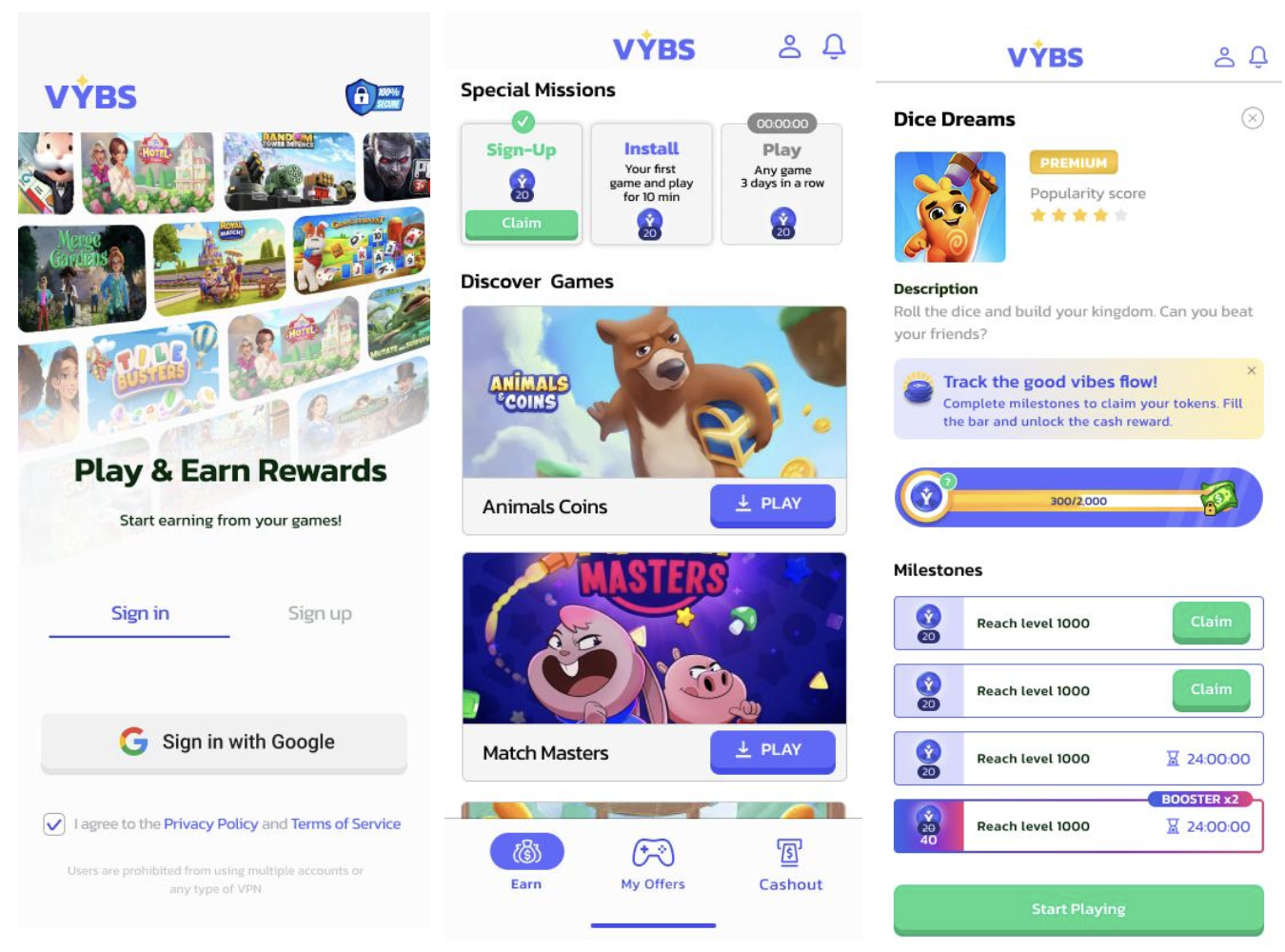
Download a loyalty app. Choose the game(s) you want to play. Earn loyalty points for progressing in the chosen games. Spend loyalty points on virtual and real-life prizes (gift cards).
A loyalty app is an app where users discover games through personalized recommendations and earn rewards based on their progression within those games. But here's what makes them fundamentally different from offerwalls:
Offerwalls are ad placements. Loyalty platforms are standalone apps living on users' devices.
While offerwalls send users outside their current game, loyalty platforms push users to stay engaged in the games they've downloaded. The business model is completely different, too.
The Player Journey
When a user signs into a loyalty platform, they're offered games based on personalization algorithms. Each game comes with tasks that are either time-based or achievement-based, like reaching a specific level. After selecting a game, users head to the app store to download it. As they progress and complete tasks, they accumulate loyalty points that can be redeemed for real-world rewards like Sephora, Zara, or Google Play gift cards.
Think of it as an app store on steroids: personalized discovery plus tangible rewards for actual engagement.
The Business Model Evolution
Game developers are the clients, and while the basic model is cost-per-install (CPI), the industry has evolved toward return-on-ad-spend (ROAS) based pricing. Instead of fixed CPIs, platforms like VYBS predict user lifetime value and price accordingly, resulting in an effective CPI that hits long-term ROAS goals.
The shift from CPI to ROAS unlocks scale because the first one is fixed, while the second one is based on the quality of the users acquired.
The Player Quality Question
The "Incentivized Traffic = Low LTV" Criticism
What happens when the reward structure ends? This is the industry's biggest challenge, but it’s solvable.
Player quality depends on multiple factors: reward structure design (linear vs. declining vs. rising), reward amounts, personalization quality, and matching users to games that fit their tastes. The biggest mistake? Glorifying rewards instead of achievements and progression.
Over-rewarding creates abuse and flatlining. Players hop from one game to another just to collect the rewards. The goal is to make rewards feel like an extra bonus, not the main motivation.
Short-Term vs. Long-Term Behavior
In the short term, loyal users behave differently: they progress much faster. But in the long term, when executed well, these users behave like users from any other channel.
Multiple clients report that once reward structures end (typically around day 45), users who stick past day 90 behave identically across all traffic sources. The users who stick just stick. They're simply retained users.
How to spot low-quality users? First, track loyalty platform users as separate cohorts. Watch progression between tasks. Poor performers drop off immediately, and it's evident in engagement data.
The advantage? Loyalty platforms let you actively work with users and push them toward specific actions, creating massive leverage when used correctly.
Genre Performance
Loyalty platforms work across all genres where long-term retention is vital, from casual to mid-core to core strategy. But casual games stand to gain the most because their recouping cycles are already shorter by default. Loyalty platforms make them even shorter, creating powerful scaling engines with healthy unit economics.
The key isn't the genre itself, but whether the studio knows how to work with loyalty platforms.
Studio Strategies
When to Start?
There's a huge advantage to approaching loyalty platforms relatively early, though not too early. You need sufficient content and reasonably mature monetization.
Here's the value proposition: A Google-acquired user might generate 200% ROAS over two years. A loyalty platform delivers 150% ROAS in four months. You're sacrificing margin points for dramatically healthier cash flow, helping smaller studios grow without lengthy wait times.
Critical Tracking Requirements
You must separate loyalty platform data from other traffic sources. Otherwise, you might build a feature that appears extremely sticky and successful, not realizing users are incentivized and behaving differently. This creates false signals about feature performance.
For studios with resources, consider more aggressive monetization for loyalty users since they're already incentivized. But always track them separately and ensure product teams see the differences when measuring performance.
The Most Overlooked KPI
Don't just look at day 7, 14, 30 flat numbers. Focus on ROAS progression rates and the shape of the LTV curve. Divide day 30 by day 14 to see the progression velocity. A cohort might miss KPI targets but show extremely healthy progression. That's the signal you’re after.
Some cohorts hit payback quickly, then flatline. Others start lower but never flatten; they just keep increasing slowly. Those users stick and continue spending, making them better long-term despite lower early metrics. Steady incremental growth matters more than explosive starts.
Studios’ Timeline to Success
There's no single answer. Some clients succeed immediately; others require significant adjustment. The timeframe ranges from one week to six or seven weeks.
Patience, nevertheless, is critical. Many UA managers make pressure-driven decisions too quickly. Success requires looking beyond day-7 metrics to evaluate the raw material quality of the users.
The Optimization Process
Loyalty platforms are one of the last media where you can optimize beyond creatives. With loyalty, you have reward structures, different events, and intimate collaboration with game studios to align live-op promotions with events you're pushing users toward.
Rather than flat progression structures like "achieve level 5, 10, 15," platforms can dynamically inject tasks like "complete the Halloween album within five days" to push real-time, season-related engagement aligned with client objectives.
Common Mistakes
Beyond expecting immediate results and failing to track separately, some studios set unrealistic KPIs, perhaps thinking they can push for 30% more than desired and settle for their actual target. This backfires and wastes everyone's resources.
Unrealistic KPIs can actually pump fraud into the ecosystem, as desperate small networks try to meet impossible targets to win clients.
Final Thoughts
The loyalty platform space has matured from an experimental side channel to a core UA infrastructure. But there’s nothing magical about them. They're sophisticated channels demanding specialization, proper tracking, and patience.
The equation is compelling: sacrifice a few margin points to compress payback, unlocking cash flow that fuels growth. For studios willing to invest in proper implementation, loyalty platforms represent one of the few remaining channels where optimization extends beyond creative testing.
Loyalty platforms work. The real question is whether a studio is ready to learn how to work with them.